
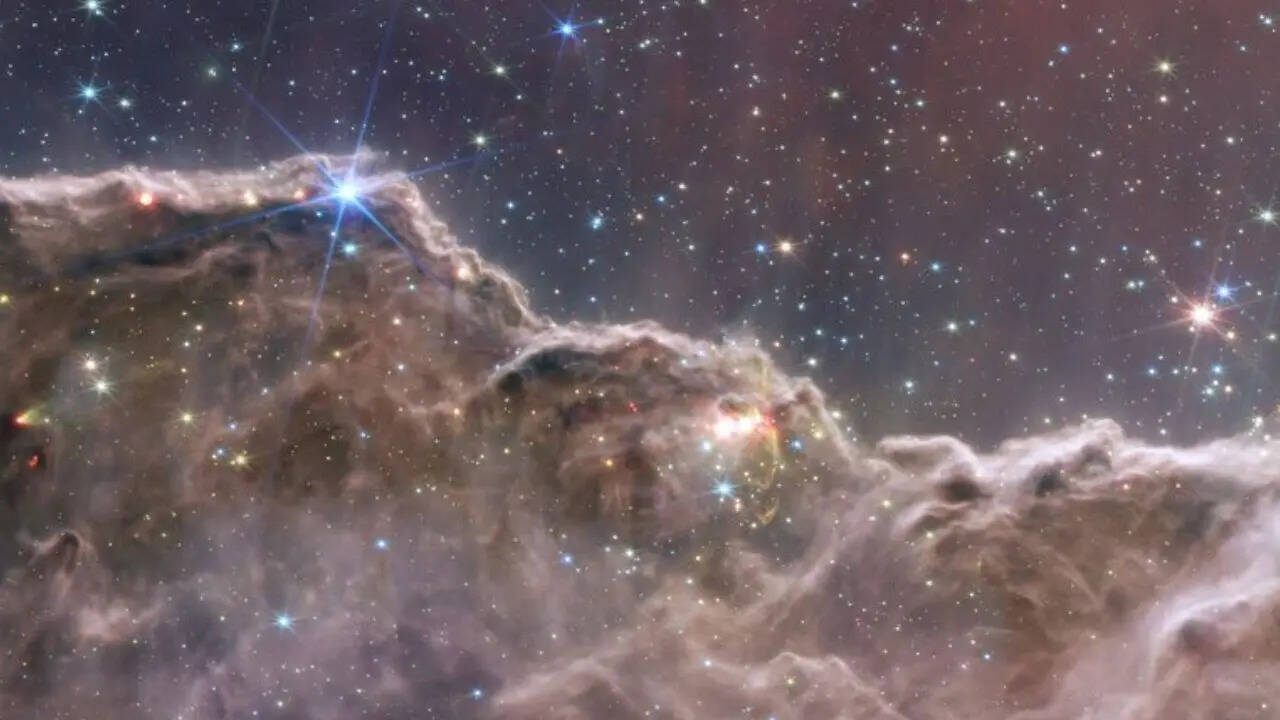
Here are some of the most beautiful pictures of the nebula, which were taken with the help of NASA’s James Webb telescope. With this telescope, astronomers can also understand the various formations and how the light from the newly formed stars affects the atmosphere.
Beautiful Pictures of Nebulae
These images show us some stunning formations and various space activities. Different types of gases and dust come together to make these amazing patterns, which we denote as Crab Nebula, Ring Nebula and more.
Ring Nebula
This image is provided by the unprecedented spatial resolution and spectral sensitivity. It also reveals concentric features in the outer regions of the nebula’s ring. It is almost 20,000 dense and is rich in molecular hydrogen. The inner region shows a very hot gas. The main shell has a thin ring of enhanced emission of carbon-based molecules known as polycyclic aromatic hydrocarbons. (Credit: ESA/Webb, NASA, CSA, M. Barlow, N. Cox, R. Wesson)
Cas A
This is a Cassiopeia A supernova remnant, and it shows a compass arrow. It takes about 3 light years to travel to a distance which is equal to the length of the scale bar. One light-year is equal to about 9.46 trillion kilometres. It shows wavelengths of light that are represented by visible-light colours. (Credit: NASA, ESA, CSA, STScI, D. Milisavljevic (Purdue University), T. Temim (Princeton University), I. De Looze (University of Gent)
Crab Nebula
This is the area which is composed of the translucent, milky material. It emits synchrotron radiation, which is emitted across the electromagnetic spectrum, and it becomes much more vibrant. It was generated by the particles accelerated to extremely high speeds as the winds surround the magnetic field lines. (Credit: NASA, ESA, CSA, STScI, T. Temim (Princeton University)
The Orion Bar region
In the centre there is a nebula which lies in a group of four hot, massive stars known as the Trapezium Cluster. The cluster lies in the top left corner, which illuminates the gas which is visible here. These two large stars in this image are a part of another cluster called θ² Orionis. There are various proplyds which are visible among the clouds of the nebula. (Credit: ESA/Hubble & NASA, M. Robberto (Space Telescope Science Institute/ESA) and the Hubble Space Telescope Orion Treasury Project Team)
Cosmic Cliffs
This craggy mountain on the top of a moonlit evening is actually the edge of a nearby young star. This region is also known as NGC 3324. This is called Cosmic Cliffs, as this rim of a gigantic, gaseous cavity is roughly 7,600 light-years away. This area has been carved by the intense ultraviolet radiation and stellar winds. (Credit: NASA, ESA, CSA, and STScI)
