
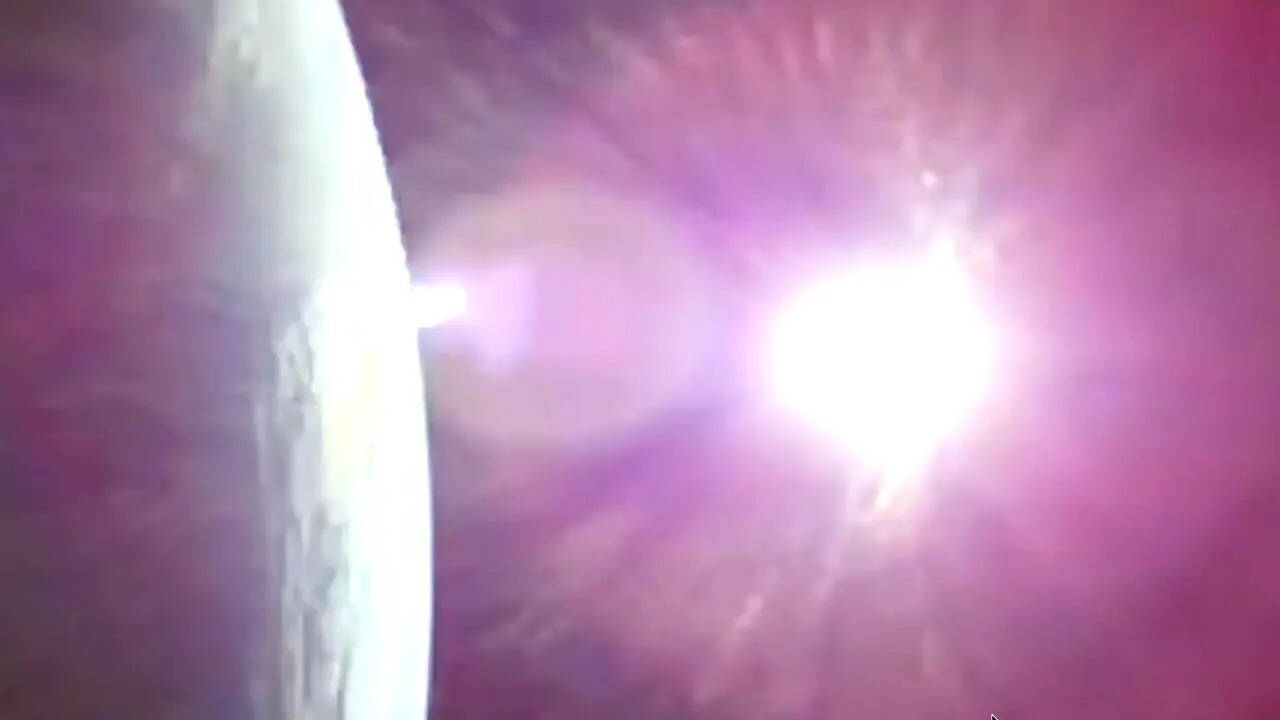
NASA has released a new video capturing one of the biggest moments of the Artemis II mission so far, the ignition of the Orion spacecraft’s main engine in deep space. The footage, posted on social media by the American space agency, shows the service module engine firing as the spacecraft begins its journey toward the Moon. It’s the kind of clip that puts the scale of what’s happening into perspective almost immediately.
The Engine Burn That Changed Everything
After receiving a go from mission control, Orion fired its main engine for five minutes and 50 seconds, a maneuver NASA calls the translunar injection burn. The engine produced around 6,000 pounds of thrust, pushing the spacecraft out of Earth’s orbit and onto a precise path toward the Moon. At the time of the burn, Orion weighed approximately 58,000 pounds and consumed nearly 1,000 pounds of fuel in the process. To put the thrust in relatable terms, NASA says it’s comparable to accelerating a car from zero to 60 miles per hour in under three seconds.
The burn also set up what’s called a free return trajectory, essentially using the Moon’s gravitational pull to loop the spacecraft around and bring it safely back to Earth without requiring a major engine firing on the way home. It’s an elegant piece of orbital mechanics that the Apollo missions used decades ago, now making a comeback in the modern era.
Life Inside Orion On The Way To The Moon
While the engine burn set the course, daily life aboard the spacecraft continues with a focus on keeping the crew fit and the systems running. Unlike the International Space Station, which has room for large exercise equipment, Orion carries a compact flywheel device weighing around 30 pounds, roughly the size of a carry-on bag. It still allows astronauts Reid Wiseman, Victor Glover, Christina Koch, and Jeremy Hansen to perform rowing, squats, and deadlifts using effort-based resistance. Ground teams are simultaneously monitoring life-support systems closely, with even minor issues like a brief communication loss after reaching orbit having been identified and resolved quickly.
What Happens During The Lunar Flyby
The US-based space agency’s lunar science team has been planning the crew’s observation schedule for the Moon flyby. During a six-hour window, the astronauts will study craters, ancient lava flows, and surface fractures. The highlight? A nearly hour-long solar eclipse as the Sun moves behind the Moon from Orion’s perspective, giving the crew a rare view of the solar corona, possible meteoroid impacts, and distant planets against a darkened lunar surface.
