
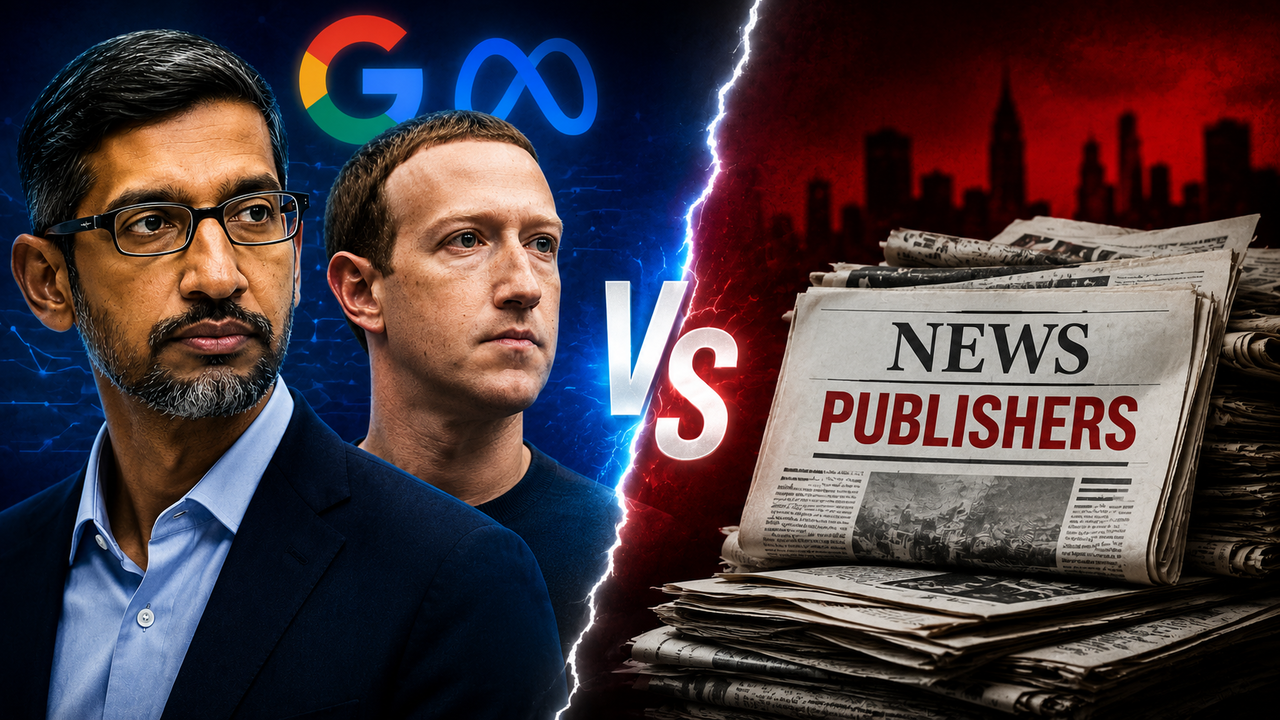
The ongoing feud between big tech and news publishers is one of the biggest issues the newsrooms are facing worldwide. In India, the discussion could evolve into a copyright battle. As Google and other tech giants continue to push AI-generated search summaries that answer user queries, legal experts suggest that these kinds of tools can replace journalism sites rather than helping users discover it.
This debate has intensified after Google expanded its AI Search features where its AI agents can scan news articles, blogs and social media posts to bring direct response for users. This has raised wider implications for news outlets in India and across the world. As many believe, users could stop visiting the original news sites leading to decreased traffic, and financial losses for them.
AI Summaries Could Replace Original Journalism
Speaking to Timesnownews.com, tech lawyer and an expert on AI governance, Shweta Bansal, explained how publishers could be impacted under Indian copyright law as AI-generated summaries start functioning as substitutes for original reporting.
“Publishers can argue that AI summaries amount to content substitution rather than content discovery. Under the Copyright Act, the owner has exclusive rights to reproduce and communicate the work to the public, and unauthorised copying can infringe copyright. An AI summary that replaces the need to click through and read the original article can be framed as a substitute rather than mere discovery, especially if it reproduces enough protected expression or captures the article’s core value.”
She highlighted how the main counterpoint is section 52 of the Copyright Act, which allows fair dealing for things like reporting current events and current affairs, including electronic storage for those purposes, but that is not a blanket license for reshaping journalism into an AI answer box.
Several media organisations argue that their content is being used by the big tech to train AI without compensating them. However, India’s current legal system does not penalise the big tech for not compensating the publishers, as proposed by Australia. Earlier this year, Ashwini Vaishnaw, the Union Minister of Information and Broadcasting, highlighted how social media platforms must ensure fair revenue sharing with those who create content. This included traditional media organisations, journalists, content creators and researchers.
Moreover, PM Narendra Modi has often spoken about the responsible and human centric governed AI systems. During international AI discussions with France and at global AI summits, he supported frameworks that can focus on AI governance and accountability.
This reflects how India is already thinking in the legal direction. However, the nation currently does not have such laws where the big tech could be accountable for using the original content of publishers.
According to the lawyer, existing Indian IT and copyright laws only provide a partial framework for regulating AI-generated answers and model training.
“The Copyright Act addresses reproduction, communication and infringement, while the IT Act primarily focuses on intermediary liability and safe harbour protections,” the expert said.
Bansal added, “But there is no dedicated statutory regime in India that specifically governs generative AI’s use of journalistic content.”
Why This Debate Matters For The Future Of Journalism
Explaining the legal distinction between content indexing and generating AI answers, the expert explained, “Section 79 protections are easier to apply when a platform is simply hosting or indexing third-party information. But when an AI system generates a direct answer, that becomes the platform’s own output, making it harder to claim intermediary protection.”
What lies ahead is that the growing debate may ultimately push governments across the world to adopt proposals like Australia and bring regulations that could make big tech pay the news outlets. China has already introduced provisional rules for generative AI, including licensing requirements for AI providers and compliance obligations. The country now requires AI-generated text, images, audio and videos to be labelled so users know the content was created by AI. Moreover, the Chinese regulators have framed an AI oversight as necessary to prevent unlawful use of content.
Spain was among the first countries to push back against the growing influence of big tech over the news ecosystem. In 2014, the country introduced rules that required platforms such as Google to pay publishers for displaying excerpts from news articles. The move led Google News to suspend its services in Spain for several years. Later, after the European Union revised its copyright framework, Spain adopted a new system that enabled publishers and technology platforms to negotiate licensing agreements directly. The country has since emerged as one of the earliest examples of governments attempting to redefine how digital platforms use and monetise journalistic content.
As AI changes how users online consume news online, the battle between big tech platforms and publishers is more like a defining policy challenge for the future of journalism. Industry experts warn that if AI-generated search experiences continue weakening direct readership and newsroom revenues, the damage could become irreversible long before regulatory frameworks catch up. For publishers, the concern is no longer just about traffic losses, but about whether original reporting can remain economically sustainable in an internet increasingly dominated by AI-generated answers.
