
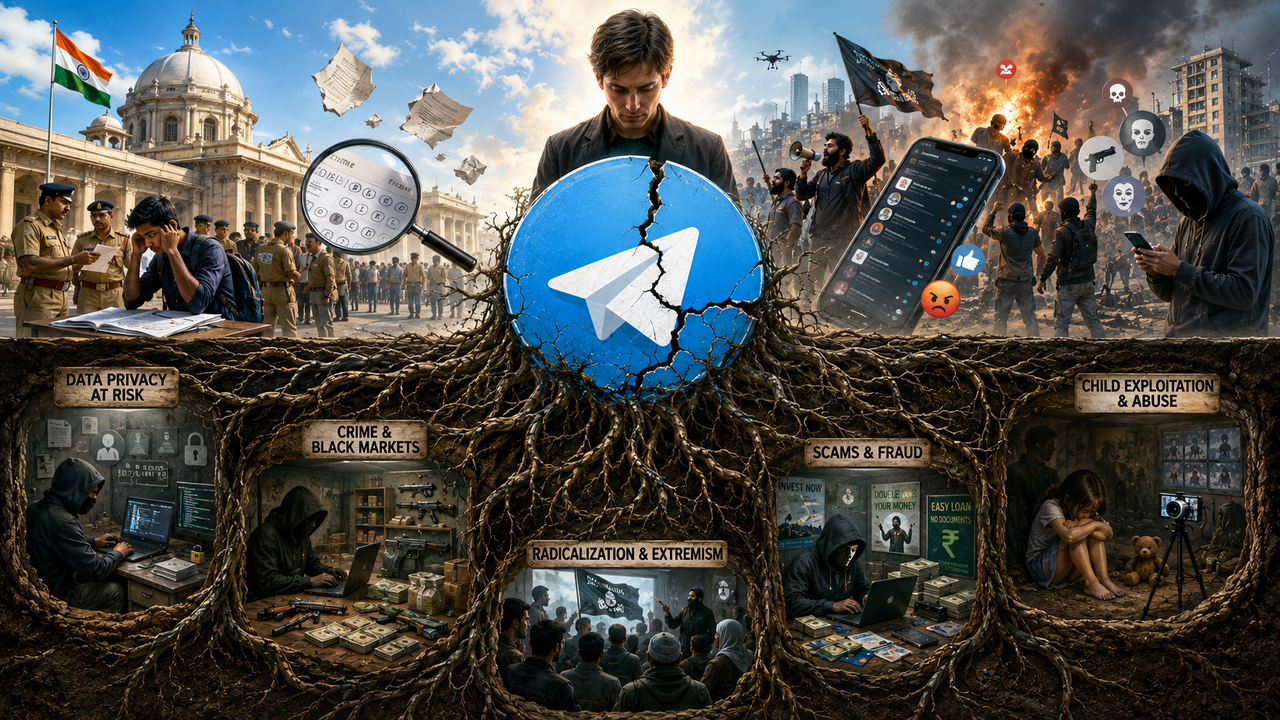
Telegram founder Pavel Durov has criticised the Indian government’s decision to temporarily block the messaging platform. On X, he said the move has “punished” more than 150 million users in the country. While Durov may have a point about millions of genuine users being caught in the crossfire, he cannot ignore that Telegram’s design – sprawling channels, light-touch moderation and a high degree of anonymity – has made it fertile ground for bad actors, from exam-leak rackets to other illegal and harmful networks.
According to tech experts, Telegram’s channel-based ecosystem has become a preferred destination for piracy networks, scammers, and data brokers because of its massive group limits, anonymity features, and ease of sharing large files.
Prabhu Ram, VP-Industry Research Group, CyberMedia Research (CMR) told Times Now Digital: “Telegram’s core challenge is balancing user freedom with platform accountability. Its low-friction, privacy-oriented architecture has driven adoption, but also increases scrutiny as governments demand stronger content moderation, anti-fraud safeguards, and compliance measures.”
He stressed that Telegram must differentiate itself from ecosystem-driven rivals such as WhatsApp and privacy-focused platforms like Signal, while preserving the openness that defines its value proposition.
Pavel Durov Hits Out at India’s NEET Exam Telegram Ban: ‘Leaks Moved to Other Apps’
“While it’s, to some extent, a good step to sort of ‘crack down’ on the chain that enables, facilitates, or makes it easy to leverage unfair means, such as access to leaked papers, etc. At the same time, it looks more like shooting the messenger than the message. Telegram here is like a pigeon. The focus has to be more on how we can ensure and have impregnable guardrails so that such leaks do not happen in the future,” Faisal Kawoosa, Founder of Techarc, told Times Now Digital.
“But yes, a crackdown on the entire ecosystem is welcome. Even if it makes access to such things difficult, it is helpful. At the same time, maybe we need stringent punitive action against students resorting to such unfair means, along with the parents who support such practices and pay for them,” he added.
According to Tarun Pathak – Research Director at Counterpoint Research, a temporary block is merely a tactical fix, not a permanent cure. Mitigating systemic issues like national exam leaks requires a highly coordinated mix of robust policy, tighter regulatory oversight, and advanced technical interventions.
“While user privacy must be respected, Telegram’s platform has actively been used by bad actors, turning its security features into tools for massive piracy, black markets, and digital fraud. Tech platforms must accept proactive accountability by introducing feature-level safeguards and strict guardrails. Ultimately, this crisis demands a deep, structural investigation into platform design rather than just a temporary network-level shutdown,” Pathak stressed.
Why Telegram Is At The Center Of Controversy
The ban by the government on June 15 stems from Telegram’s alleged misuse during the NEET exam row. The Ministry of Education and the National Testing Agency (NTA) said channels on the platform were being used to circulate what were claimed to be leaked question papers and answer keys.
The NTA described the block as a “last resort”, saying repeated channel-by-channel takedowns had failed to stop the fraud networks.
But Telegram’s troubles in India predate the current paper-leak row.
Over the years, the platform has been linked to piracy, online scams, data leaks and the circulation of illegal content. The same features that make it popular with ordinary users, large public channels, a degree of anonymity and frictionless file-sharing, also lower the barrier for cybercriminals trying to reach a wide audience quickly.
Indian authorities have stepped up scrutiny on several fronts. The centre recently ordered Telegram to disable more than 3,000 channels distributing pirated films, TV shows, software and study material.
Last year, a Digit report found Telegram bots being used to sell the personal data of Indian users, and separate reports alleged that private hospital CCTV footage of women was being circulated and sold through channels on the platform. Such cases have raised recurring questions about whether the platform does enough to curb misuse.
Telegram is not alone in facing these problems. Similar issues have been reported on other platforms, including Discord, Slack, WhatsApp and Instagram. What sets Telegram apart is scale and reach: a single public channel can amass thousands of subscribers in hours, which means leaks, piracy, scams and misinformation can spread faster and prove harder to contain once they take hold.
Telegram’s troubles, however, go beyond the current paper leaks
Over the years, Telegram has often been linked to issues such as piracy, online scams, data leaks, and the sharing of illegal content. Its large public channels, anonymous groups, and easy file-sharing features have made it a popular platform not just for regular users, but also for cybercriminals and fraudsters looking to reach a wider audience.
Reliance Sabotaging Telegram Access For Millions Of Users Outside India, Alleges CEO Pavel Durov
The NEET paper leak controversy is only the latest chapter in Telegram’s long list of problems. Lately, Indian authorities have increased scrutiny of Telegram over piracy, illegal content, and cybercrime-related activities.
The Central Government recently ordered the platform to disable more than 3,000 channels involved in distributing pirated movies, TV shows, software and educational material. Last year, a report by Digit found that Telegram bots were being used to sell personal data of Indian users.
In another disturbing case, reports claimed that private hospital CCTV footage of women was being circulated and sold through Telegram channels.
Such cases have raised serious questions about whether Telegram is doing enough to prevent misuse of its platform and stop harmful content from spreading.
Well, Telegram is not the only platform facing these challenges. Similar issues exist across social media and messaging services.
However, Telegram’s setup makes it harder to control harmful content. Large public channels can quickly gain thousands of followers and this allows illegal content, piracy, scams, and misinformation to spread very fast.
The temporary ban may not have completely stopped paper leaks, as Durov claims but it has brought attention to a much larger issue. The debate is no longer just about exam papers. It is about piracy networks, data trafficking, illegal content, and the responsibility of digital platforms.
