
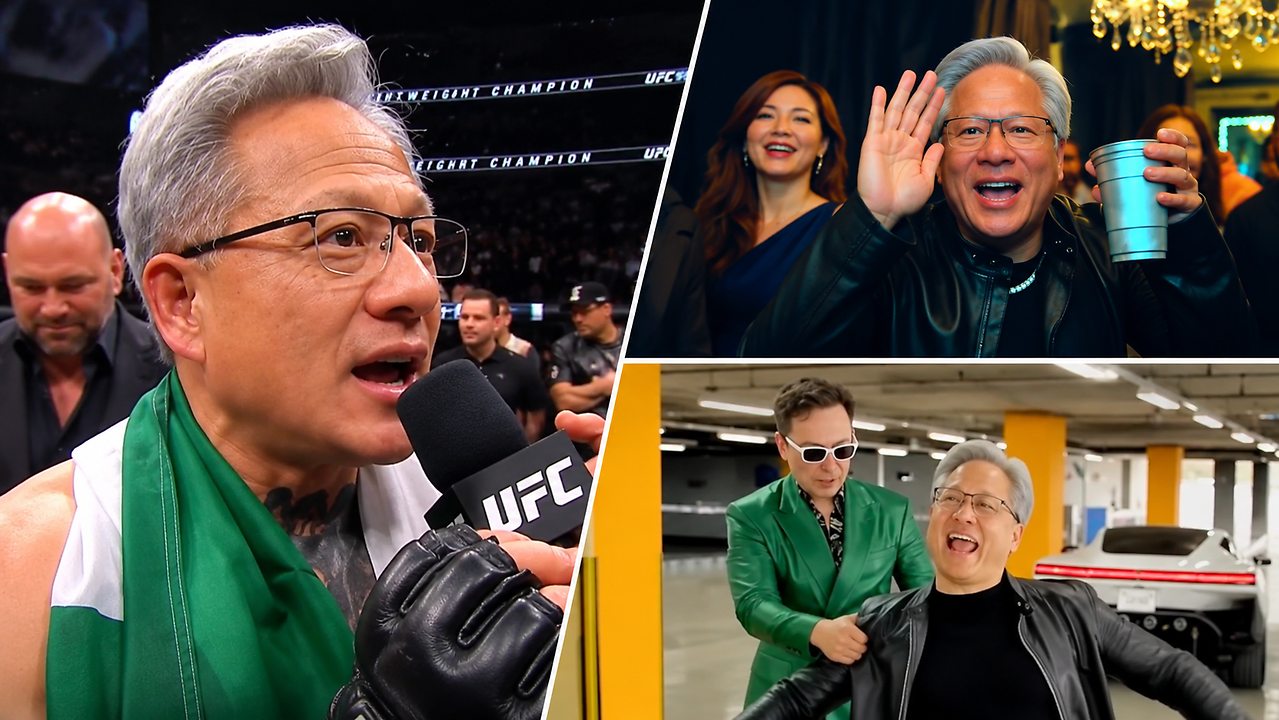
A potato. An internet meme. A pole. A WWE wrestler. A retired NBA player. Ajay Sharma from Bazigar. A character from a drama series. A poster of a Netflix series. What’s common between all these? I have seen Nvidia CEO Jensen Huang on all of them in the last two weeks, thanks to AI.
One moment, he is staring out of a pixelated screen with that unmistakable leather jacket silhouette. The next, he is charging towards the wrestling ring, or looking broodingly from a streaming drama poster.
It began when a wave of AI memes flooded my feed around the drama of Jensen Huang being sacked, and it roared right back when the news of his reinstatement broke. Within days, a single person’s likeness had been lifted from reality, pasted onto half a dozen unrelated cultural artefacts, and turned into low-effort visual punchlines at scale.
I will keep Jensen aside from here on. This isn’t about him. Look closer at what is actually happening. We are watching the quiet dissolution of personal likeness in real time. The unspoken rule of the modern internet has shifted from you share what you want to once it is indexed, rendered, and remixed, it belongs to the feed.
Today, it’s the CEO of world’s biggest company. Yesterday, it was a cricketer. Tomorrow, it will be a Bollywood actor, politician or any public personality.
Internet remix culture is not new. For two decades, people have slapped faces onto movie posters, photoshopped politicians into absurd backgrounds, and turned awkward press conference stills into reaction images. Something that instantly comes to mind were the endless edits of Keanu Reeves sitting alone on a park bench. The difference is those relied on a single, static photograph being cropped and dropped into a new frame.
Even that had certain speed bumps. You required time, basic design skills, a sourced photo and some willingness to learn and sit in front of an editing tool.
Generative AI has obliterated those speed bumps.
Today, turning a face into a video clip, a stylised character, or a mashup takes only a good prompt and few seconds. We have seen this play out so much in the last few months: Elon Musk rendered as a toddler or Taylor Swift dropped into streets she never visited. An artist even had a fake album generated in their name.
On short-video platforms, entire trends now revolve around swapping celebrity faces onto dancing toddlers, classic 90s sitcom intros, or generic trends to get views. The quality and brilliance of these videos entirely depends on the large language model you are using. And, it’s scary.
This brings me to the actual raw material enabling all of this: your face. A texture pack, a weight in a latent space, a convenient hook to stop someone from scrolling past a reel at 11 PM.
Because, attention is scarce and familiar faces are instant scroll-stoppers. A recognisable face carries built-in context, status and emotional shorthand. When an AI generator puts a famous face onto something incongruous, your brain registers the face before your rational mind asks whether any of it actually happened.
Even when a meme is obviously meant as a joke, the underlying muscle memory of the internet is changing. We are training ourselves to treat human faces as assets rather than anchors of real presence and accountability. When someone’s face can be effortlessly placed anywhere, the boundary between what a person did, what a person said, and what an algorithm assembled gets blurrier by the week.
What should worry the rest of us even more is how easily this logic trickles down to ordinary people. Anyone with a public social profile, a tagged wedding photo, a LinkedIn headshot, or a shared family album on an open link leaves digital breadcrumbs behind. We are already seeing early versions of this: colleagues dropping a teammate’s headshot into an AI sticker pack for a WhatsApp group or just anyone using their friend’s face for a viral dance reel.
Most of it is framed as harmless banter. Yet the underlying precedent is identical to the Jensen Huang potato memes: if your face is accessible on a server somewhere, someone else gets to decide what body, scene, or punchline it wears next.
Legally and culturally, we are still playing catch-up. Sadly, there is no copyright on your face.
Several high-profile personalities have gone to court over unauthorised voice and likeness clones but even they are facing an uphill battle. For an everyday user without a legal team, practical control is close to zero.
So where does that leave us? Swearing off the internet entirely is neither realistic nor necessary. What we do need is a colder, clearer-eyed realism about how visibility works in the age of generative AI.
First, treat every public image as permanent and portable. Assume that anything posted openly whether a keynote still, a LinkedIn portrait, or a holiday selfie can be cropped, or dropped into a trend without your permission, and lock down what does not need to be public.
Second, keep a healthy dose of skepticism on your own timeline: just because a face looks convincing in motion does not mean the moment ever existed.
