
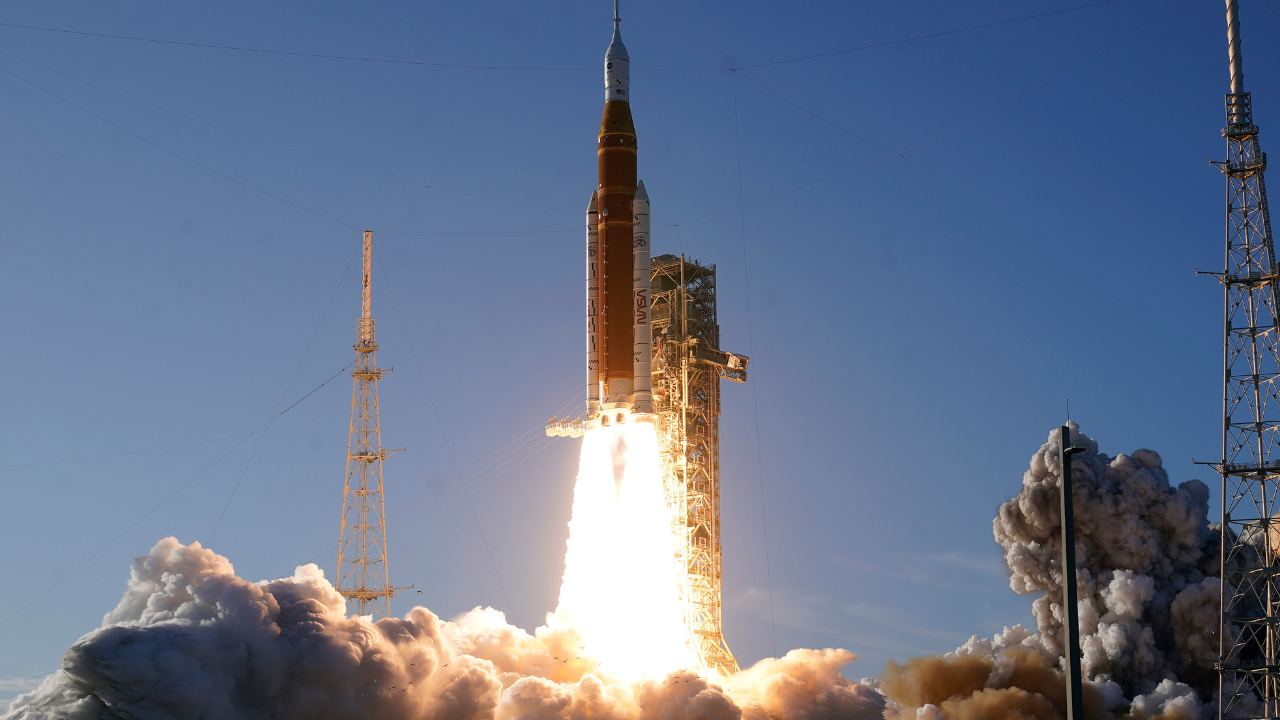
NASA on Thursday gave the green light to the four astronauts aboard the Artemis II mission to leave Earth orbit and begin their journey to the Moon. The decision came after mission teams reviewed the spacecraft’s performance and confirmed it was ready for the next phase. Flight Director Jeff Radigan informed the crew that they could fire the Orion capsule’s engine to move onto a lunar path, according to AFP report.
The engine burn is set to last 5 minutes and 49 seconds. It will push the spacecraft out of Earth orbit and begin a three-day trip to the Moon. This marks the first crewed mission heading toward the Moon since 1972.
NASA said flight controllers will watch engine performance and navigation data closely to ensure the spacecraft stays on the correct path.
All About Artemis II Mission
The astronauts launched aboard the powerful Space Launch System rocket from the Kennedy Space Center in Florida. The launch took place without any major issues. The Orion capsule entered a high Earth orbit before preparing for the journey ahead.
The crew includes Reid Wiseman, Victor Glover, Christina Koch, and Jeremy Hansen. They spent their first hours in space checking systems and fixing minor problems. These included a communication issue and a problem with the spacecraft’s toilet. NASA officials said both issues were addressed.
Also Read | The India Link In Artemis Mission: Who Is Amit Kshatriya – The Brain Behind NASA’s Moon Chase
NASA chief Jared Isaacman said the astronauts were doing well. He wrote, “The Orion spacecraft is performing well in an impressive elliptical orbit.” The crew also tested systems to ensure the spacecraft remains safe and reliable during the mission.
The Artemis II mission is a key step in NASA’s plan to return humans to the Moon. The mission will last about 10 days and will take the crew around the Moon before bringing them back to Earth. It will test systems needed for future lunar landings planned later in the decade.
Also Read | NASA Artemis II Launches Successfully: What Happens Next In The 10-Day Moon Mission
The mission also marks several historic firsts. It includes the first woman, the first person of color, and the first non-American astronaut to take part in a lunar mission. If the mission goes as planned, the astronauts will travel more than 250,000 miles from Earth, farther than any humans have gone before.
The Artemis program aims to build a long-term presence on the Moon. NASA plans to use the Moon as a base for future missions to deeper space. The effort also reflects growing competition in space exploration, especially with China, which plans to send astronauts to the Moon by 2030.
The program has faced delays and rising costs over the years. The rocket had to return to its hangar for repairs before launch. Despite these challenges, the mission has now moved forward.
(With inputs from AFP)
