
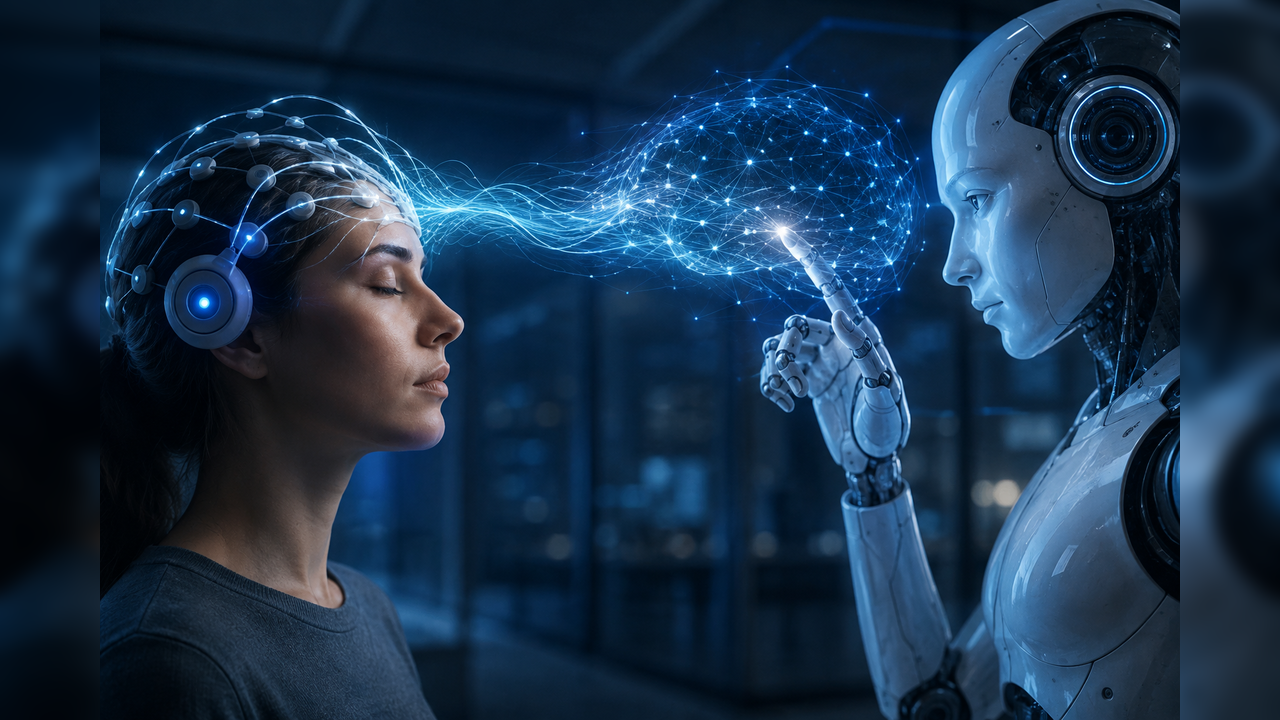
Former OpenAI alignment researcher Naomi Bashkansky took to social media platform X and announced that she has left the company to join AI startup Conduit as a founding researcher, where she says the team is working on technology that could one day allow AI to understand human thoughts without surgery.
“Two weeks ago, I resigned from OpenAI to join Conduit as a founding researcher, where we’re training models to non-invasively read the human mind. I’ve written some thoughts about what telepathy could look like by 2035 and how to get there,” Bashkansky posted on X.
Bashkansky, in a blog post, revealed that she resigned from OpenAI on July 23 and joined Conduit the very next day.
According to her, Conduit is developing “thought-to-text models, trained on non-invasive neural data.” The means the system will to convert a person’s thoughts into text using brain signals collected without implanting chips inside the brain.
In her blog, she imagined a future where people communicate with AI assistants using only their thoughts.
Bashkansky predicted that by 2027, users could wear a lightweight neural headband connected to their computers. Instead of typing prompts, the device would interpret their intentions and automatically send them to AI models.
Describing the experience, she wrote, “I’m not saying words really loudly in my head while getting coffee. I just read the plots as I normally do, and make coffee as I normally do. It feels like magic.”
Bashkansky believes that by 2030, people could communicate with AI using their thoughts. AI may be able to understand brain signals directly without turning them into text first.
By 2035, she believes AI will no longer feel like a separate tool.
“It will become a natural extension of me that feels like a sixth sense and another limb, allowing people to think, learn and interact with technology more naturally,” she added.
Explaining how the technology works, Bashkansky said Conduit is collecting massive amounts of non-invasive brain data to train AI models. She argued that perfect brain decoding is not necessary for useful applications because AI models can combine noisy brain signals with language understanding and context.
“To train models that can predict text given brain signals, we must apply the same lesson learned by those predicting text given speech audio, or text given preceding text: the bitter lesson. The lesson roughly states that you should throw more useful compute at your model, and your model will become better than any ingenious algorithm you could’ve hand-crafted,” she noted.
