
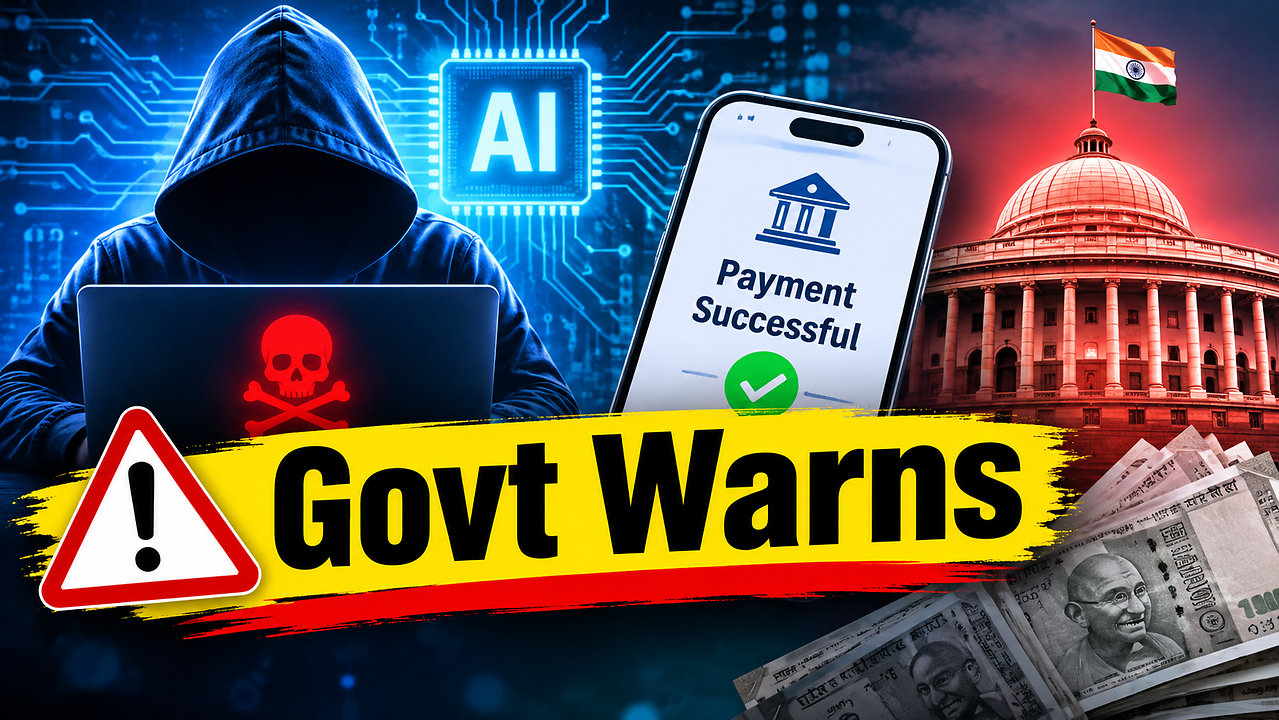
As AI agents continue to advance, the government has warned about the increasing misuse of AI driven hacking tools and unauthorised financial transactions through business payment systems. This latest advisory comes from CERT-In, highlighting how hackers are exploiting business apps, payment workflows and approval mechanisms to carry out fraud transactions, while also using AI-powered tools to automate cyberattacks.
The critical level advisory was issued on November 20, 2026 and it warns that these threats are no longer limited to banks and financial institutions. Technology service providers supporting government-linked payment processes and platforms handling vendor and partner payouts have also been affected.
How The Attacks Take Place
According to CERT-In, recent incidents have revealed how attackers are manipulating business payment workflows to divert money through otherwise legitimate systems. Instead of directly attacking payment gateways or exploiting payment APIs, cybercriminals are targeting the business applications and approval processes that determine when and where payments are made.
The attackers have reportedly altered business records or approval relationships associated with payments before using established payment processes to execute unauthorised transactions. They have also exploited gaps in independent verification and reconciliation procedures to avoid immediate detection.
This means that even transactions passing through an organisation’s usual application and approval checks may not always be legitimate.
Apart from financial fraud, CERT-In has also raised concerns about the use of AI-driven agentic offensive frameworks (AOFs) in cyberattacks targeting different sectors.
These frameworks can automate several stages of an intrusion, reducing the amount of manual effort required by attackers. CERT-In’s proactive threat-hunting activities identified their use against enterprises, technology service providers, government organisations, and academic and research institutions. The agency identified several techniques associated with these attacks, including automated reconnaissance to identify exposed systems, services and possible entry points.
CERT-In Issues Cybersecurity Recommendations For Organisations
To address these threats, CERT-In has recommended several security measures for government organisations, technology service providers and other businesses.
Government organisations and owners of services operated through technology providers have been advised to identify accounts, systems and integrations that can modify payment-related records, approve transactions or access sensitive information. They should also ensure that payment instructions and critical business records maintained by service providers are checked against independent records.
The agency has also recommended independent verification for high-risk changes involving payment instructions, beneficiaries and approval arrangements. Organisations should not rely entirely on multiple approvals within the same service-provider-controlled system, as a compromised environment could affect all those approval mechanisms.
Technology service providers and IT-enabled services (ITES) companies have been asked to separate client environments and restrict administrative accounts, credentials and control-plane privileges. Access provided to one client should not allow unauthorised access to another client’s systems.
Businesses have also been advised to monitor changes to payment-related records alongside privileged account activity, approval actions and subsequent transactions.
