
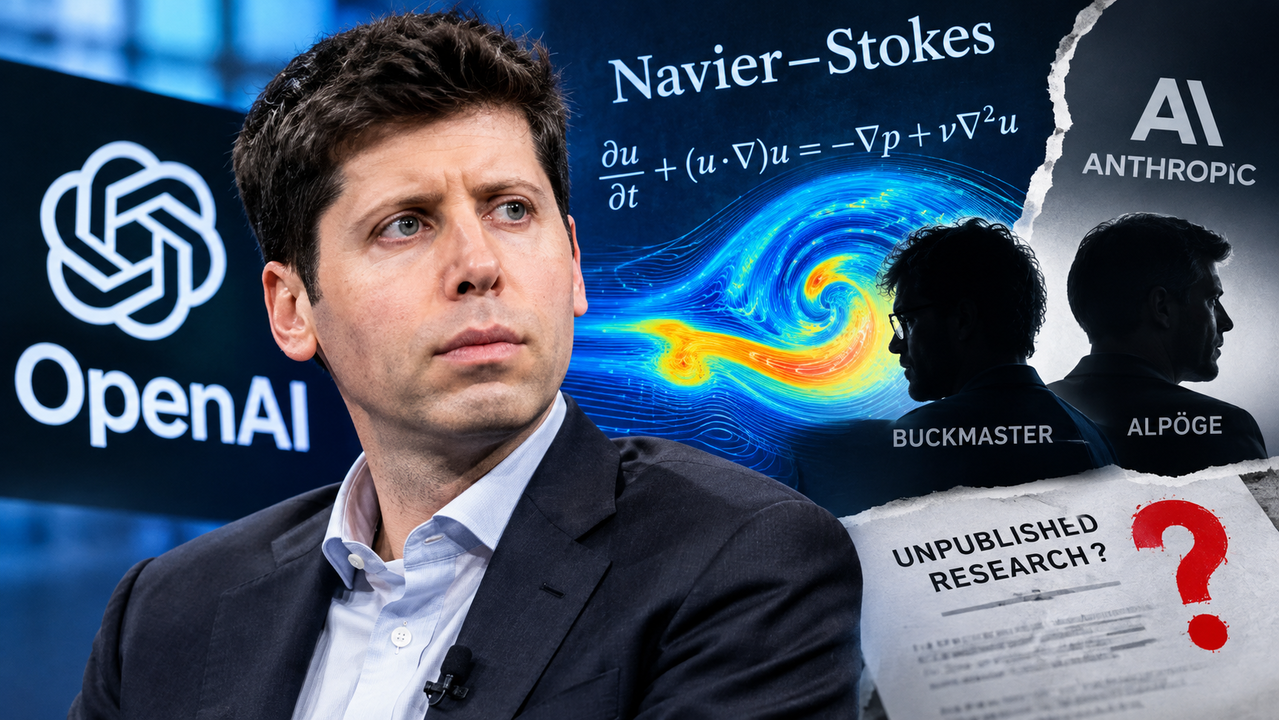
OpenAI has once again landed up in a controversy. The company claimed that one of its advanced AI models has solved a 100-year-old math problem that has remained unsolved for decades. However, the announcement has also raised questions about whether OpenAI’s researchers may have benefited from unpublished work by other mathematicians and an Anthropic researcher working on a closely related problem.
Here’s What Happened
According to OpenAI, one of its unreleased AI models produced a proof showing that the three-dimensional Navier–Stokes equations can develop a singularity in finite time. OpenAI said its effort began on September 1 after researchers heard rumours that two of the famous Millennium Prize Problems had been solved. The company then turned its attention to the remaining problems and used a new internal AI model that OpenAI described as being “significantly more capable than GPT-6 Astra”.
According to OpenAI executives, around 10,000 AI agents were involved in the effort. The company said it spent millions of dollars in computing resources while trying to solve the problem. The Navier–Stokes equations are used to describe how fluids move. Understanding them could have applications across science and engineering, including areas such as weather modelling and the study of blood flow.
Mathematicians Raise Concerns Over Unpublished Research
According to Axios, the announcement has become controversial because NYU mathematician Tristan Buckmaster and Anthropic researcher Levent Alpöge had been working on closely connected fluid-dynamics research. Buckmaster has reportedly questioned whether OpenAI’s researchers may have moved towards a research direction after learning about work being done by the pair. He has also raised concerns about whether private material from Codex could have played a role.
The tech firm strongly denies that its researchers or AI agents had access to Buckmaster and Alpöge’s work before it was publicly released. The company has acknowledged that the two groups were working on related ideas based on earlier research.
OpenAI CEO Sam Altman addressed the issue on X, saying, “Now that we can see their work, the approaches appear to be different.” Altman also confirmed that OpenAI began the project after hearing rumours that Anthropic’s models had solved a major mathematics problem. He stated, “We were curious if ours could do it too.”
Moreover, the controversy has also raised wider questions about whether private user information could have been used during the AI research process. OpenAI’s policies state that data from paying enterprise customers is not used for training, while consumer users have the option to opt out of having their data used for training.
Mark Chen, OpenAI’s chief research officer, said no user information was used to solve the problem. He said, “No people or AI systems searched through user data to solve this problem.” Chen added, “I’m a little disappointed with the allegations.”
Notably, the controversy over Buckmaster and Alpöge’s research adds another layer to the story. It concerns how researchers can be sure that an AI system’s breakthrough is genuinely new, rather than influenced by information it may have encountered elsewhere.
