
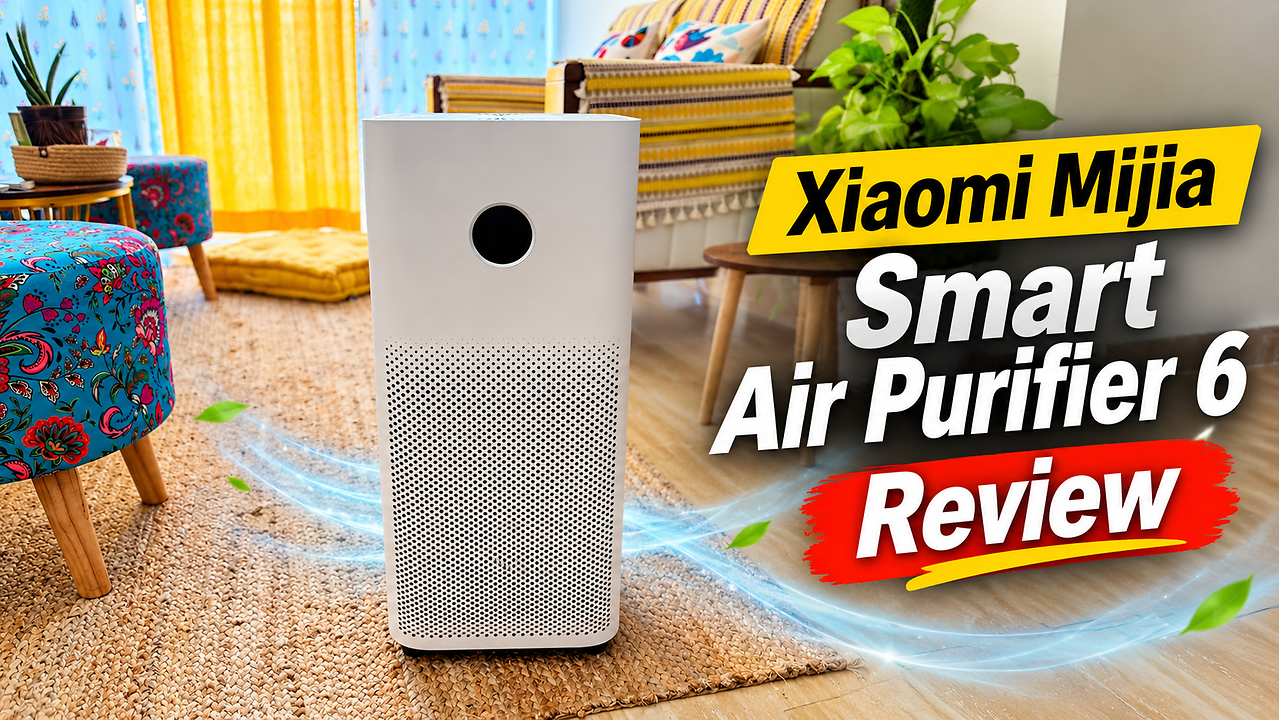
Last few weeks have been an annual reminder that air purifiers aren’t a luxury anymore. They are an absolute necessity. Especially, if you live in parts of North India. I have been getting several messages and calls for recommendations as well. And, while there are usual options from Dyson, Philips or Honeywell, Xiaomi’s Mijia Smart Air Purifier 6 has emerged as this exciting alternative to the traditional offerings, finding a sweet balance between price and performance.
For the unversed, Xiaomi is going big on home appliances and has announced its new brand Mijia earlier this year. One of the first products to come under this is the Mijia Smart Air Purifier 6. And, I have used it over the past month, including the greyest days for Delhi-NCR. Here’s everything you need to know about it, in case you are planning to purchase one.
Compact design
One of the first things you’ll notice about the purifier is its compact footprint. Measuring just 25x25x55.5 cm, it doesn’t take up much floor space, making it easy to tuck into a corner of a living room or bedroom. Weighing around 5.2 kg, it’s also light enough to move between rooms without much effort. That’s what I have been doing on most days — often unplugging and moving between different areas of the house.
The clean white finish makes a lot of sense for a home appliance because it blends into modern interiors without drawing attention. That said, the matte white exterior can get dirty quickly, especially in dusty conditions, so you’ll need to wipe it down regularly to keep it looking fresh.
Is it effective?
At the end of the day, this is what matters the most. With a 443 m³/h Particle CADR, the Mijia Smart Air Purifier 6 is built to handle large spaces up to 940 sq ft (based on two air changes per hour), which made it more than enough for my living room as well as the main hall. Both of these areas have a full sized window, which is often open for fresh sunlight, also bringing in outside ventilation. Also, I have an open kitchen extending into the living room.
This made for the perfect testing ground to see how fast the machine reacts to sudden pollution spikes. It takes a short while to settle in after you first turn it on, but once running, it responds quickly to changes in air quality.
Opening the front door or letting kitchen smoke drift in triggers the fan to ramp up almost immediately. Even on severe pollution days when Delhi’s AQI pushed past 700, it consistently held the indoor AQI below 50, keeping the room comfortable even with occasional window openings or active cooking.
That strong airflow comes with a trade-off in sound. On its highest setting, the fan noise is noticeable and can distract you during quiet hours. During the day, it’s easy to ignore, though at night the higher speeds feel intrusive unless you switch to Sleep Mode, which drops the noise down to 32 dB(A).
Beyond basic dust trapping, the five-stage filtration system uses a pre-filter, a high-efficiency filter, and activated carbon to tackle PM2.5, PM1, odors, and harmful gases. It also includes UVC sterilization and a negative-ion function to round out its air treatment.
Smart Features
An air purifier is mostly a utility appliance. If it cleans the air well, I can forgive missing extras, though good smart controls make daily use nicer. Here, the Mijia Smart Air Purifier 6 offers a mixed bag.
It works with the Mi Home app and links with third-party voice assistants, including Google Home and Amazon Alexa. Apple HomeKit support is missing, which is a notable gap for iPhone households, and there’s no clear confirmation of Matter support either.
While the Mi Home app tracks historical trends across its five sensors, covering PM1, PM2.5, dust, temperature, and humidity, Alexa+ mainly acts as a basic remote rather than a tool to analyse your room’s data.
Long-Term ownership costs
Xiaomi built its reputation on aggressive pricing, and this model follows that playbook. Priced around Rs 18,999, it isn’t a basic budget unit, yet it undercuts many rival purifiers with similar room coverage. However, all air purifiers demand a recurring cost, including replacement filters. Finding spare filters can also be a headache.
Xiaomi lists replacement filters at Rs 3,499. At those rates, long-term upkeep looks much kinder on your wallet than many competing brands.
There is, however, an important catch. Xiaomi embeds an RFID tag inside the filter assembly so the machine checks for genuine parts. That blocks cheaper third-party filters and ties you strictly to Xiaomi’s own supply chain. If official filters go out of stock during peak winter smog, you have no choice but to wait for restocks.
Final verdict
Choose the Xiaomi Mijia Smart Air Purifier 6 if you want fast, heavy-duty air cleaning in a compact white tower that handles severe AQI spikes without breaking the bank. Skip it if you rely on Apple HomeKit or prefer the freedom to buy third-party replacement filters.
Before bringing it home, factor in both the price and local stock of official filters rather than looking at the upfront cost alone.
