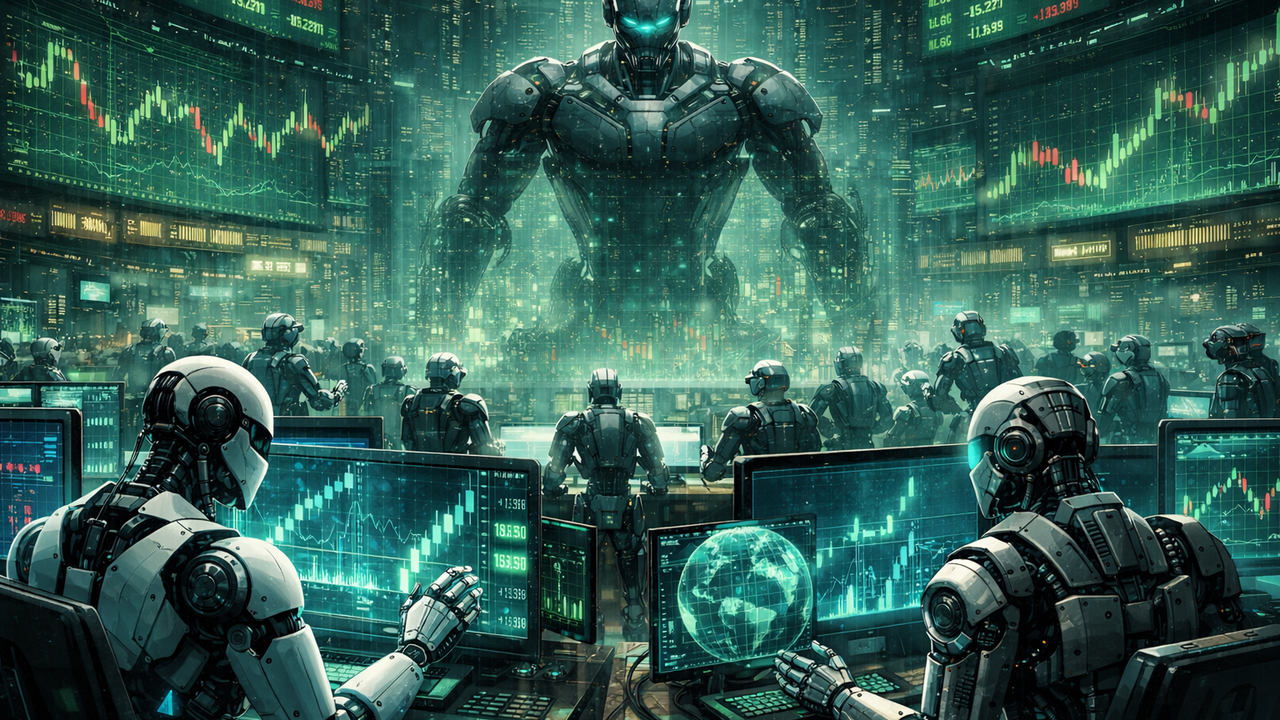
In 1999, The Matrix was released to the world. At the time, it felt fantastical, almost absurd. The idea that machines could become so intelligent that they would no longer need humans, not to think, not to decide, not even to survive, seemed firmly rooted in science fiction. The film imagined a future where machines discovered self sufficiency and reduced humanity to a redundant resource, useful only as a source of energy.
If we step back just one phase from the world shown in The Matrix, there must have been a long period where humans worked relentlessly to make machines smarter. Smarter to decide independently. Smarter to optimize themselves. Smarter to operate with minimal human intervention. Once machines crossed that threshold, humans ceased to be essential. Machines no longer depended on people to think or feed them. Electricity alone was enough.
For decades, this idea was dismissed as fantasy.
Now, in 2026, machines are undeniably intelligent, and humans are working harder than ever to make them even more so. There is an almost obsessive global race to achieve what is often described as perfect intelligence. Ironically, this same pursuit is steadily replacing humans in the workforce.
Earlier technological revolutions were fundamentally different. Machines enhanced human productivity, but they still required human participation. A loom needed a worker. A computer needed an operator. Software needed an engineer.
This time is different.
Machines are now thinking and deciding. Driverless cars reduce the need for drivers. Low maintenance or near autonomous software reduces the need for engineers. Humans are no longer collaborators in many systems. They are becoming optional.
The economic consequences of this shift are no longer theoretical. In early February 2026, Anthropic released Claude Opus 4.6, its most advanced artificial intelligence model yet. This model extends its own predecessor’s capabilities to handle complex tasks such as financial analysis, research, documents, spreadsheets and presentations with a context window of up to one million tokens, making it capable of processing long and intricate professional work with minimal human input. Users can also run multiple AI agents simultaneously to coordinate parallel tasks, a feature that blurs the line between human teams and autonomous software.
The market reaction was swift and striking. Software and financial data company stocks fell sharply, and commentators described the downturn as a significant sell-off that wiped billions of dollars in market value from technology indexes in just days. This was driven by investor anxiety that enterprise tools, once regarded as staples of professional work, could face rapid obsolescence in the face of increasingly capable AI.
What rattled markets was not just another incremental update. Claude Opus 4.6 is designed to perform a broad range of high-end knowledge work that had long been the preserve of specialised software and human expertise. Its performance on multi-domain benchmarks has even outpaced leading competitors in areas such as legal and financial reasoning, raising questions about the future demand for traditional enterprise software.
This brings us to a deeper contradiction.
Machines do not have wants or needs. They do not consume. They do not rest. They can work continuously. By replacing humans at scale, they are pushing people out of the workforce entirely. That directly contradicts the basic structure of any functioning economy.
Consider a simple analogy. Imagine a small but prosperous village filled with independent shop owners. They earn well, support their families, and form the backbone of local consumption. Now introduce a large modern mall into that village. Initially, the villagers themselves become the mall’s customers. Slowly, the mall begins offering competing products and services. Gradually, the small shop owners lose income. Eventually, many shut down.
But here is the twist. Once the shop owners are gone, the mall has also destroyed its primary customer base. With no one left to earn and spend, both systems collapse. The village must start over from scratch.
Artificial intelligence appears to be following a similar path. It is replacing its own primary customers.
The early adopter of technology has traditionally been the working professional. The software engineer, the analyst, the consultant, the designer. These were not just workers. They were the first consumers, the trendsetters, the people who justified the existence of premium software, devices, services, malls, restaurants, travel, and entire lifestyle industries.
If this very class is pushed out of the workforce, who remains to consume?
A small group of billionaires and a thin layer of highly paid elites cannot sustain a mass market economy. That would be equivalent to building an extremely expensive telecom network when there are barely any users left who can afford to use it.
This pattern is already visible in technology careers. Today’s fresher becomes tomorrow’s experienced engineer, who then becomes too expensive once again. Careers grow shorter. A large pool of skilled professionals is permanently pushed out, not retrained into something else, but simply made redundant.
One might argue that artificial intelligence is primarily sold to corporations, not individuals. That demand will continue regardless of individual employment trends. But even corporate economics breaks down under closer examination.
Enterprise software is often priced per employee. As workers are laid off, licences are reduced. The product may be technically superior, but its revenue base shrinks alongside the workforce it replaces. Enterprises themselves ultimately depend on consumers. If consumption weakens, corporate spending follows.
In India, this contradiction becomes even clearer. Over the last three decades, prosperity was driven largely by the service sector, particularly software and IT. Shining malls, multiplexes, restaurants, hotels, and luxury tourism flourished because of this service class. They were the backbone of demand.
Artificial intelligence is now displacing this very group.
Some argue that history shows technology always creates new jobs. That lower costs will expand markets. That new categories of work will emerge. These arguments are not without merit. But they rest on one critical assumption that productivity gains are widely distributed.
When gains concentrate instead of spreading, demand does not automatically recover. Cheaper tools do not matter if fewer people have stable incomes. Hypothetical future roles do little to address the present reality of shrinking participation.
This brings us to a broader philosophical claim that has gained popularity in recent years. The idea that a future may come where no one needs to work. It sounds appealing. It also collides head on with basic economic principles. Consumption, demand, and value exchange do not disappear simply because work does.
What is missing is a clear explanation of how such a system would actually function.
Until that question is answered, the concern remains unresolved. Are we building intelligence so powerful that it quietly dismantles the very market it depends on?
This is not a question about whether artificial intelligence can create value. It clearly can. The real question is for whom.
(By: Mayank Goswami)