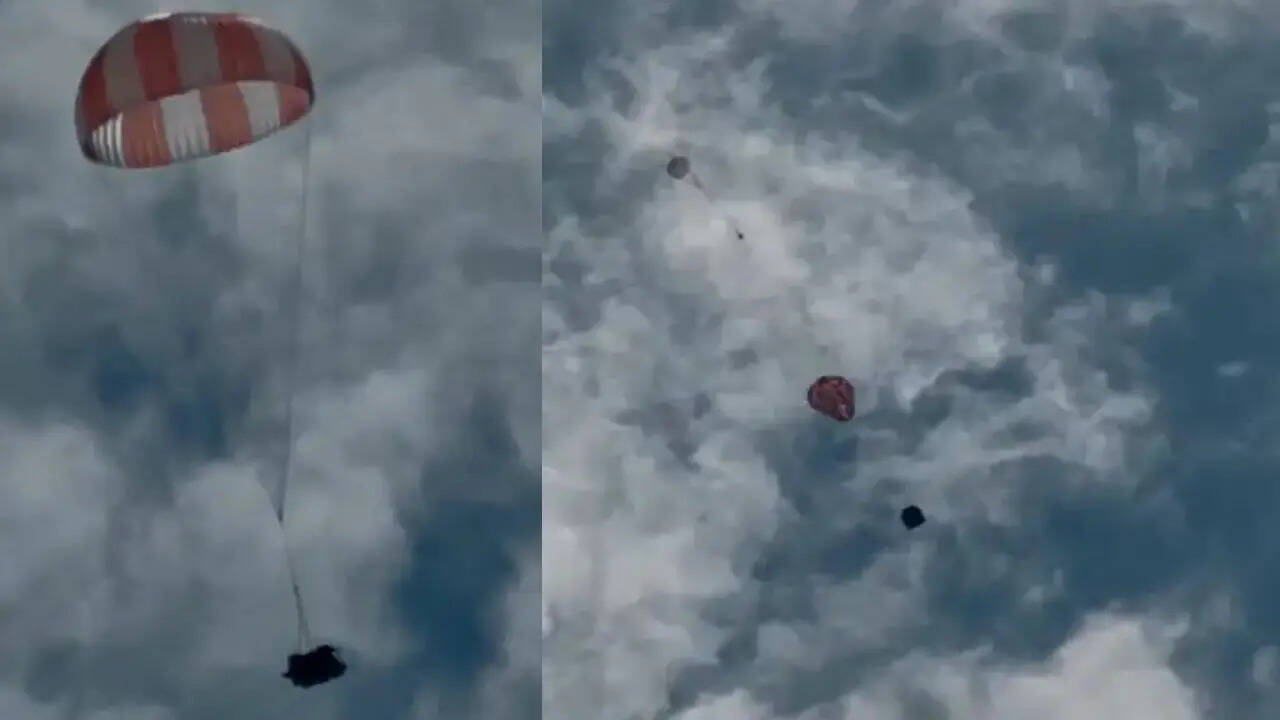
The Indian Space Research Organisation (ISRO) has successfully conducted a key qualification test of the primary parachute system for the Gaganyaan crew module. This could be dubbed one of the biggest milestones in India’s first human spaceflight mission. As for the test, it was carried out at the Aerial Delivery Research and Development Establishment (ADRDE) drop zone in Sheopur, Madhya Pradesh, to authenticate the parachute system designed for the crew module’s safe descent and landing.
The Indian Space Research Organisation (ISRO) said in a statement, ‘The objective of this test was to qualify the main parachute for its structural integrity and design margins under the maximum expected load conditions in the first uncrewed Gaganyaan G1 mission.’ At the time of testing, a simulated assembly containing a single primary parachute and a dummy payload was dropped from an altitude of 2.5 km by an Indian Air Force IL-76 aircraft.
Right after the release, a drogue parachute was deployed to stabilise the assembly and considerably reduce the descent speed. The main parachute was then deployed, bringing the payload down to a safe terminal velocity for landing. ISRO also said, ‘This is the 5th test in a series of integrated main parachute airdrop tests (IMAT) to qualify the critical main parachute for the Gaganyaan Mission. The successful completion of IMAT-05 provides necessary confidence in the performance and reliability of the Main Parachute System for the first Uncrewed Gaganyaan Mission (G1).’
The Gaganyaan crew consists of a parachute system including 10 parachutes of four different types and each designed to get sone with a specific function during descent. It consists of two drogue parachutes for stabilising and slowing the descent, along with three pilot parachutes that independently extract and deploy the three main parachutes. Apart from that, it also has two apex cover separation parachutes which jettison the protective apex cover shielding the parachute compartment from the intense heat generated during atmospheric re-entry.