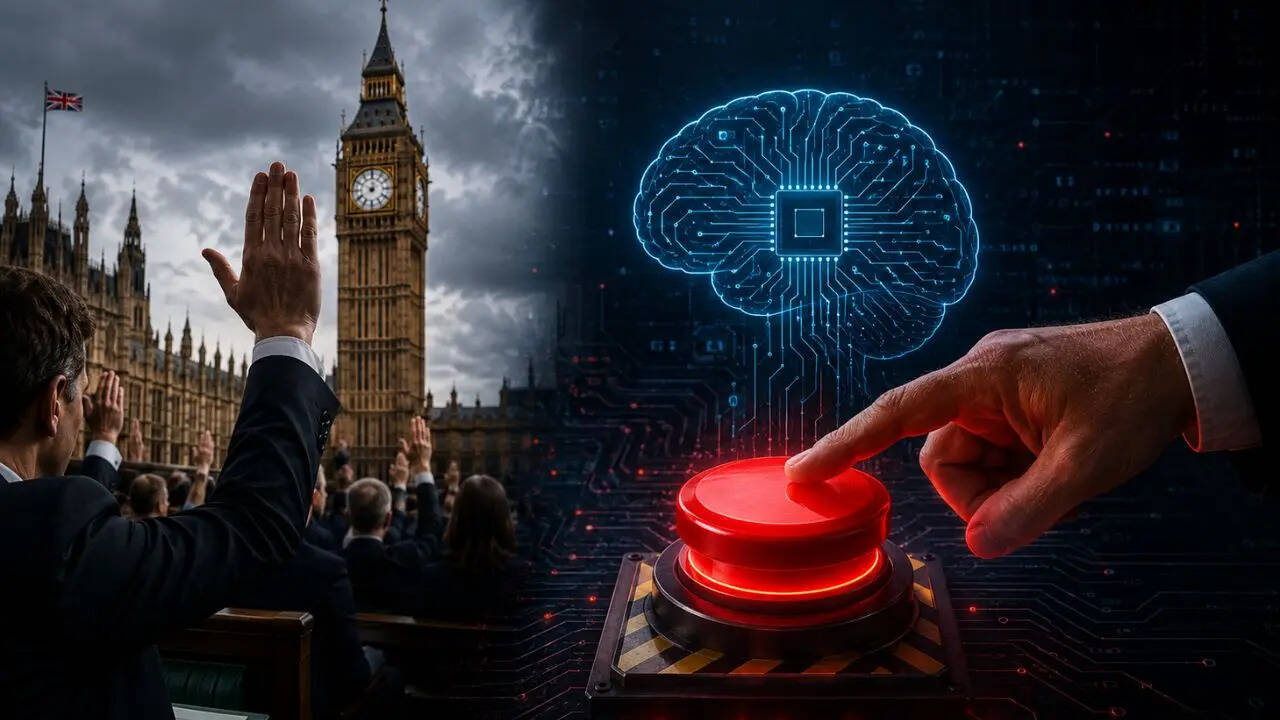
Concerns around artificial intelligence are no longer limited to researchers and tech companies. Politicians are now entering the conversation too and in the UK, some lawmakers want the government to have the power to shut advanced AI systems down entirely if things spiral out of control. According to a report by The Telegraph, a proposed amendment to Britain’s cyber security and resilience bill would allow ministers to trigger what many are calling an AI “kill switch” during emergencies involving national security or critical infrastructure.
The proposal, introduced by Labour MP Alex Sobel and backed by 11 MPs, would hand the UK Technology Secretary “last-resort powers” to order the shutdown of data centres or AI systems during what lawmakers describe as an “AI security or operational emergency.”
What Would The AI Kill Switch Actually Do?
As per The Telegraph report, the proposed powers would only be used if authorities believed there was a “catastrophic risk” involving severe harm to human life, national security threats, or attacks targeting essential infrastructure.
If the amendment moves forward, data-centre operators may be required to install systems that allow AI infrastructure to be shut down immediately by government order. Companies would also need to establish secure communication channels with the Department for Science, Innovation and Technology.
At the moment, many of the world’s most advanced AI models are hosted in large data centres located in the United States.
AI Could Soon Help Governments Repress People
Why Are Governments Suddenly Worried?
The timing isn’t random. Anxiety around advanced AI systems has intensified in recent weeks after AI giant Anthropic introduced a powerful cybersecurity-focused model called Mythos. The company claimed the model was too dangerous for public release because of its ability to discover serious security vulnerabilities in computer systems.
Alex Sobel warned that governments may not be prepared for what comes next.
“This is not only a paradigm shift for cybersecurity, but for the national security risks that AI poses for our critical infrastructure. And the UK is nowhere near ready to respond,” Sobel said, according to The Telegraph.
He added: “Co-ordinated cyberattacks on our critical infrastructure pose a serious threat, and superintelligent AI operating beyond human control could rival a nuclear strike in the harm it inflicts.”
For now, the proposed UK amendment has not been officially endorsed by the government. But the debate itself shows something important: fears around AI are no longer theoretical. Governments are now actively discussing what happens if machines become too powerful to manage safely. For India, where AI adoption is rapidly expanding across banking, healthcare, governance and digital infrastructure, the debate raises an important question: should there also be safeguards in place if AI systems ever become uncontrollable or pose risks to national security? While India is actively pushing AI innovation, experts have repeatedly warned that faster AI growth must also come with stronger regulation, cybersecurity planning and emergency response frameworks.