
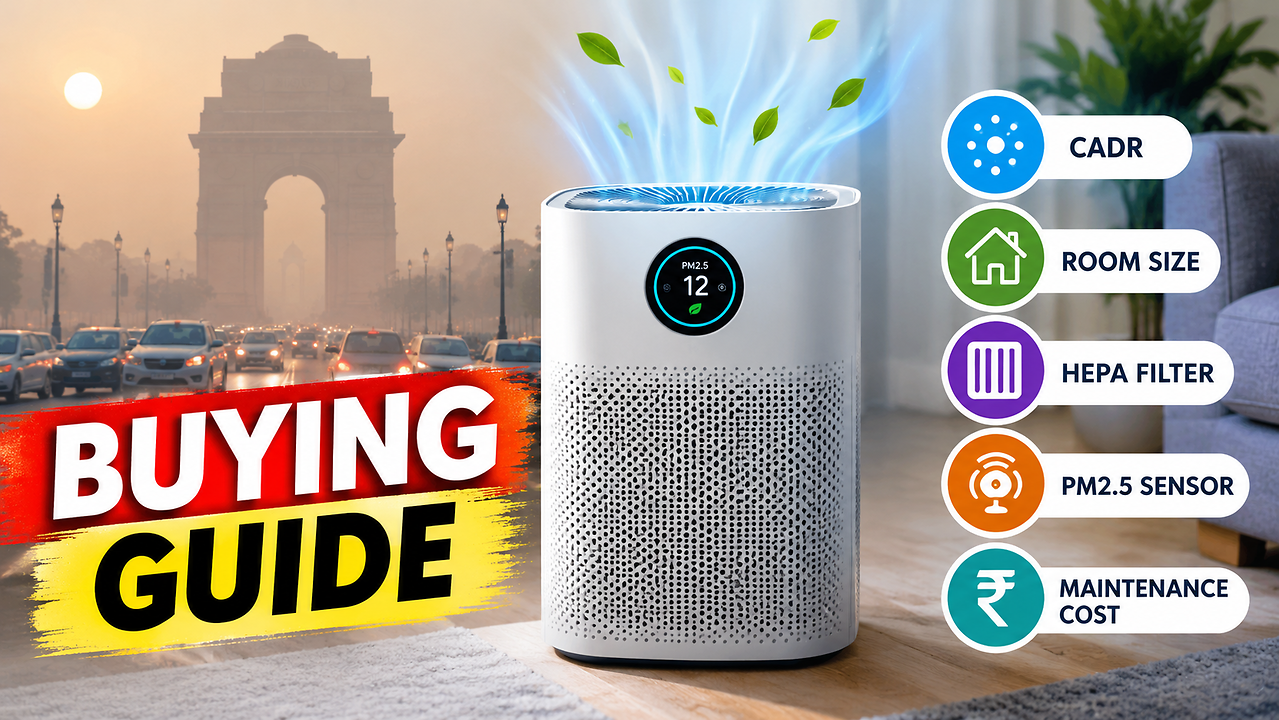
As winter approaches in northern states of India, air pollution remains a concern especially in Delhi and the National Capital Region (NCR). Many households should consider buying an air purifier to improve indoor air quality. However, choosing the right device can be confusing, with brands offering different filtration technologies, room coverage, air-cleaning speeds and smart features at varying prices. An expensive air purifier is not necessarily the right choice for every home. Factors such as the size of the room, filter efficiency, Clean Air Delivery Rate (CADR), maintenance costs and noise levels can determine how well a device suits your needs.
If you are planning to buy an air purifier for your home, here are five things to check before making a decision.
1. Check The CADR Rating Before Buying
The Clean Air Delivery Rate (CADR) indicates how quickly an air purifier delivers filtered air into a room. It is one of the most important technical specifications to check when comparing different models.
CADR is commonly measured in cubic feet per minute (CFM) or cubic metres per hour (m³/h). A higher CADR generally means that the purifier can clean the air faster, provided the figures are measured using comparable testing methods.
Some manufacturers provide separate CADR ratings for smoke, dust and pollen. For Delhi residents concerned about PM2.5 pollution, the smoke CADR can be a useful comparison point because it relates to the removal of fine airborne particles.
Do not compare CADR figures alone. The rating should also be considered alongside the room size, filter performance and noise level at the fan speed used to achieve that rating.
2. Choose An Air Purifier According To Your Room Size
Before purchasing an air purifier, calculate the area of the room where you want to use it. Measure the length and width of the room to calculate its area in square feet. Then compare it with the manufacturer’s recommended coverage area and CADR rating.
Another technical specification worth understanding is the Air Changes Per Hour (ACH). It indicates how many times an air purifier can deliver an amount of filtered air equivalent to the room’s entire air volume in an hour.
For example, an ACH rating of 5 means the purifier delivers filtered air equivalent to five room volumes per hour under the stated conditions. This does not mean that every particle is removed after each air change. For heavily polluted environments, consider a purifier capable of achieving around four to five air changes per hour, or the level recommended by a reliable sizing guide for your room. Ceiling height, indoor pollution sources and the device’s actual operating speed also matter.
3. Look For A Genuine HEPA Filter
High-efficiency particulate air (HEPA) filtration is an important feature to consider when buying an air purifier for Delhi’s pollution. A true HEPA filter is generally designed to capture at least 99.97 per cent of particles measuring 0.3 microns under specified test conditions. This includes many fine airborne particles, although actual performance in a room also depends on the purifier’s design, airflow and filter condition.
Check the manufacturer’s technical documentation to understand the filter standard and its tested efficiency. Do not rely on marketing terms such as “HEPA-type” or “HEPA-like”, which may not offer the same performance as a properly specified HEPA filter. A pre-filter can capture larger particles, including hair and dust, while an activated carbon filter can help reduce certain odours and gases. However, carbon filters vary in their ability to remove gaseous pollutants, and a particulate filter alone does not remove every type of pollutant.
4. Check PM2.5 Monitoring And Air-Quality Sensors
Some air purifiers include a built-in particle sensor that measures airborne particulate matter and displays an air-quality reading. This can help users monitor changes in indoor air quality and understand when the purifier needs to increase its fan speed. PM2.5 refers to fine particles with a diameter of 2.5 micrometres or less. These particles are a major concern during periods of severe air pollution because they can penetrate deep into the respiratory system.
Check whether the purifier displays a numerical PM2.5 reading or only a colour-coded air-quality indicator. Also, look for details about the sensor’s measurement range and accuracy.
A built-in sensor is useful for monitoring trends, but it is not necessarily as accurate as a calibrated air-quality monitoring instrument. An indoor PM2.5 reading also does not indicate the concentration of every pollutant, such as ozone or nitrogen dioxide.
5. Calculate Filter Replacement And Maintenance Costs
The purchase price is only part of the cost of owning an air purifier. Replacement filters can add considerably to the expense, particularly if the device is used for several hours a day during Delhi’s pollution season. Check the price and availability of replacement HEPA and activated carbon filters before purchasing a model. Manufacturers may specify a recommended replacement interval, but actual filter life depends on pollution levels, operating hours and maintenance.
A washable pre-filter can help capture larger dust particles and protect the main filter. However, this does not mean the HEPA or activated carbon filter can also be washed. Compare the estimated annual maintenance cost across models. A cheaper purifier may become more expensive to operate if its replacement filters cost more or are difficult to find.
