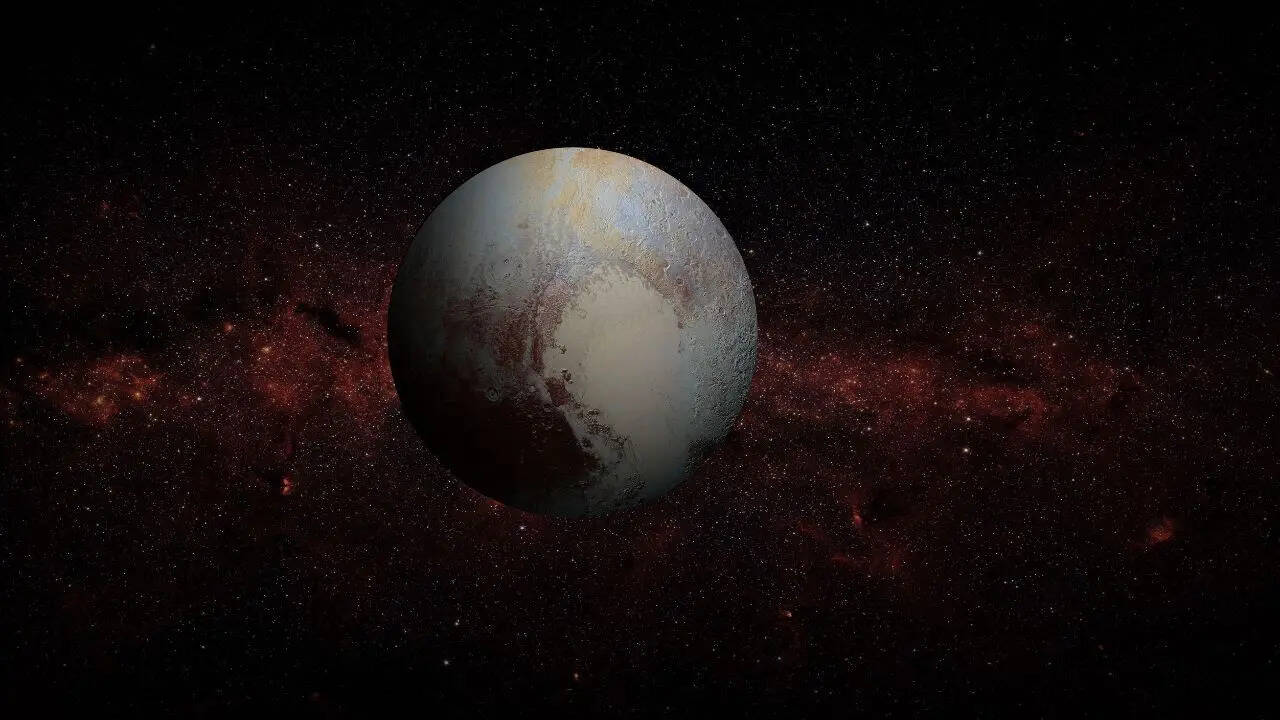
Far beyond Neptune, in one of the coldest and most remote corners of our Solar System, astronomers have stumbled upon a mystery that wasn’t supposed to exist. A distant icy object known as 2002 XV93 appears to be surrounded by a thin layer of gas, a surprising discovery because the object is simply too small to hold onto an atmosphere for long. The finding has left scientists searching for answers and wondering whether something unexpected is happening on this frozen world beyond Pluto.
The discovery emerged when researchers observed 2002 XV93 passing in front of a distant star, a technique often used to study objects too far away to examine directly. Instead of merely blocking the starlight, the object appeared to reveal signs of material surrounding it, hinting at the presence of a possible atmosphere.
That is where things get interesting. At roughly 470 kilometres wide, 2002 XV93 is nowhere near large enough to maintain a stable atmosphere over billions of years. Its gravity is weak, meaning any gases should have escaped into space long ago. Yet the observations suggest something may still be lingering around it.
Scientists now have several theories. One possibility is that the object was recently struck by another icy body in the Kuiper Belt, releasing trapped gases beneath the surface and creating a temporary cloud around it. Another idea is even more intriguing: cryovolcanism, sometimes described as icy volcanism, where frozen materials and vapours erupt from below the surface.
Science After Chandrayaan-3, Isro Is Building A Moon Lander That Can Last For 200 Days: Here’s How
Neither explanation has been confirmed. Researchers also point out that current observations cannot yet determine exactly what the surrounding material is made of. More data will be needed before they can understand what is really happening.
What makes the discovery especially important is what it could reveal about the Kuiper Belt itself. Often viewed as a collection of frozen leftovers from the Solar System’s formation, these distant objects may be far more dynamic than previously thought.
For now, 2002 XV93 remains a cosmic puzzle. If future observations show the atmosphere fading away, a recent collision could be the culprit. If it persists, scientists may have uncovered evidence of ongoing activity on a world once thought to be completely dormant.