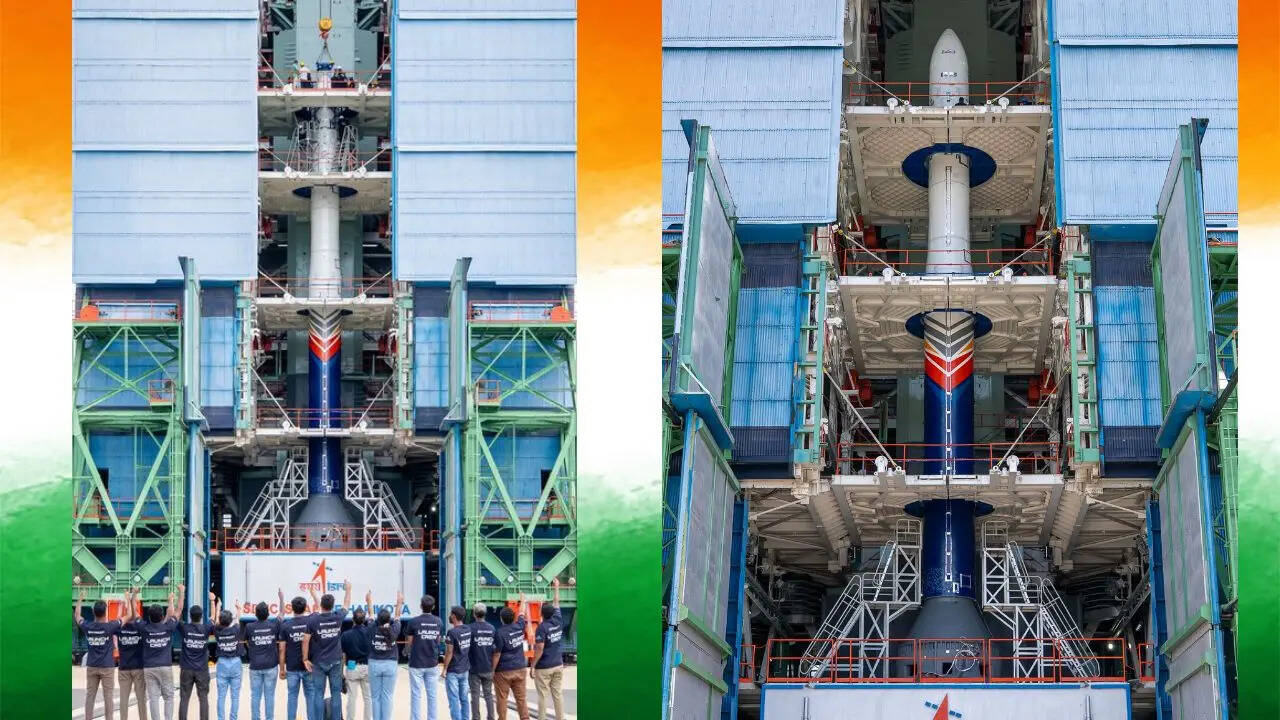
One of the most ambitious Indian space programmes is on its way to achieve a historic milestone today with Skyroot Aerospace’s Vikram- 1 ready on the launch pad at the Satish Dhawan Space Centre in Sriharikota for its orbital mission at 11:30 AM. Dubbed Mission Aagaman, the flight is the first attempt by a privately designed, developed, and built orbital-class rocket to launch from India. The seven story tall launch vehicle, developed by Hyderabad-based Skyroot Aerospace, has completed all the checks on the pad.
The integrated vehicle tests have been successfully carried out by the engineers along with telemetry interface checks and radar tracking validation. Skyroot Cofounder and cEO Pawan Kumar Chandana said, ‘We have done everything that could be done to test Vikram-1 on the ground. On July 18, we are eager to see how Vikram-1 performs in the real flight environment for the first time.’
Vikram 1 is going to attempt to place multiple tech payloads into a 450KM Low Earth Orbit at a 60-degree inclination. The rocket has the capacity to carry loads up to 356Kg and has a chassis based on an all-carbon composite structure powered by in-house developed propulsion systems comprising 3D-printed engines and high-thrust solid rocket motors. As for the payloads, it consists of technology demonstrators from Grahaa Space. Cosmoserve, Dcubed, and Skyroot’s SCOPE experiment. This mission will carry symbolic payloads as well, including Prime Minister Narendra Modi’s handwritten postcard reading ‘Vande Mataram.’
Skyroot is expecting that all the data that will be collected during the mission will make the way for estasblishing a reliable launch and facing off the global small satellite launch market. Both the founders of Skyroot, Pawan Chandana and Naga Bharath Daka have said that a good liftoff will be the parameter of success for them and the mission will purely focus on collecting as much data as they can for future space ambitions of India.