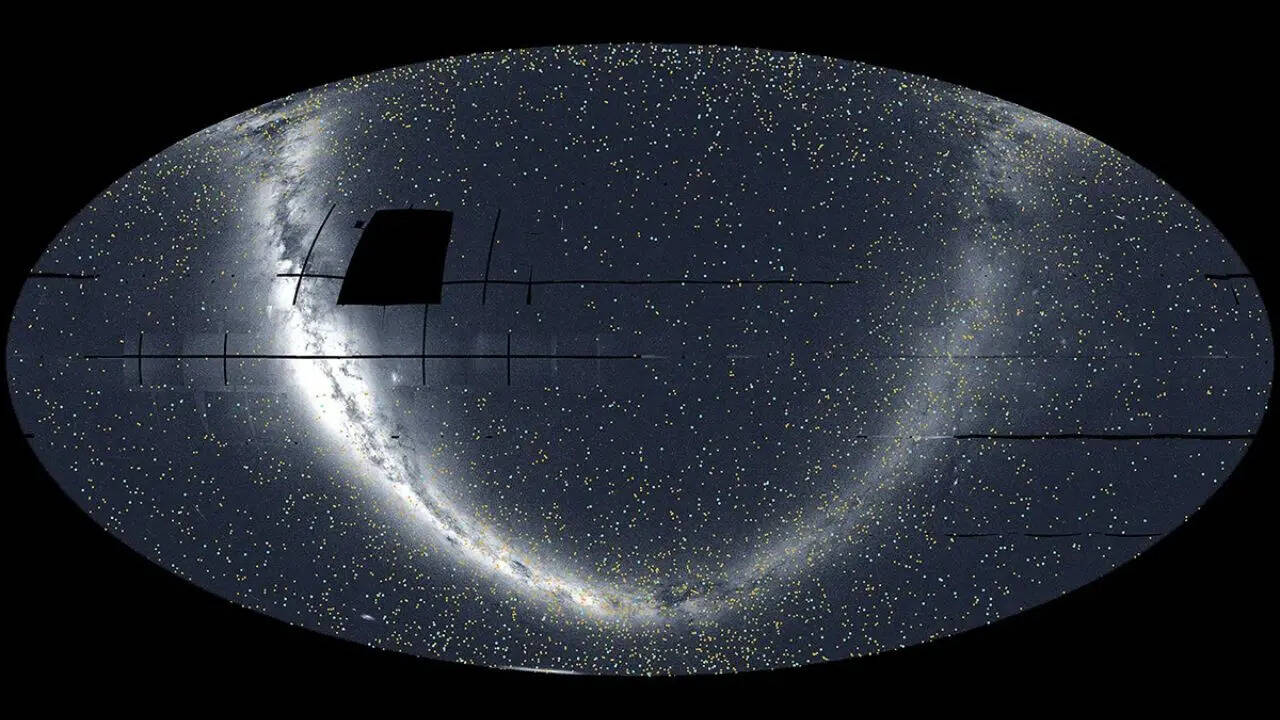
NASA has shared what may be one of the most detailed visual records of the night sky ever assembled. The image, created using data collected by the Transiting Exoplanet Survey Satellite (TESS), combines eight years of continuous observations into a massive cosmic map filled with thousands of colourful planetary markers. The visual includes 96 sky sectors captured between April 2018 and September 2025. Scattered across the image are more than 6,000 bright dots, each representing either a confirmed exoplanet or a possible planetary candidate orbiting distant stars. And honestly, the scale of it is slightly overwhelming to look at. Tiny coloured points spread across the darkness, each potentially representing an entirely different world.
How NASA’s TESS Telescope Finds Hidden Planets
According to NASA, TESS searches for planets using something called the transit method. The space telescope continuously watches the brightness of thousands of stars at the same time. When a planet moves across the front of a star, even briefly, the star’s light dims ever so slightly. That tiny flicker is often enough to reveal the presence of an orbiting world.
TESS uses four wide-field cameras to scan different sections of the sky for nearly a month before shifting to another region. Over time, that slow and systematic approach has helped build one of the largest exoplanet catalogues ever created.
But planets are not the only thing TESS has spotted. NASA says the mission has also captured near-Earth asteroids, streams of young stars and energetic activity from distant galaxies.
This New Route To The Moon Could Make Space Travel Cheaper, Here’s How
Nearly 6,000 Alien Worlds Have Been Identified
By September 2025, NASA says TESS had already confirmed 679 exoplanets, while another 5,165 planetary candidates were still awaiting verification through follow-up studies and observations.
Some of these worlds are smaller than Mercury. Others are giant gas planets even larger than Jupiter. A few potentially sit inside the so-called habitable zone, where temperatures may allow liquid water to exist under the right conditions.
According to NASA, researchers recently identified a planetary system with an unusually tilted orbit, along with evidence suggesting two planets may have violently collided in the past.