
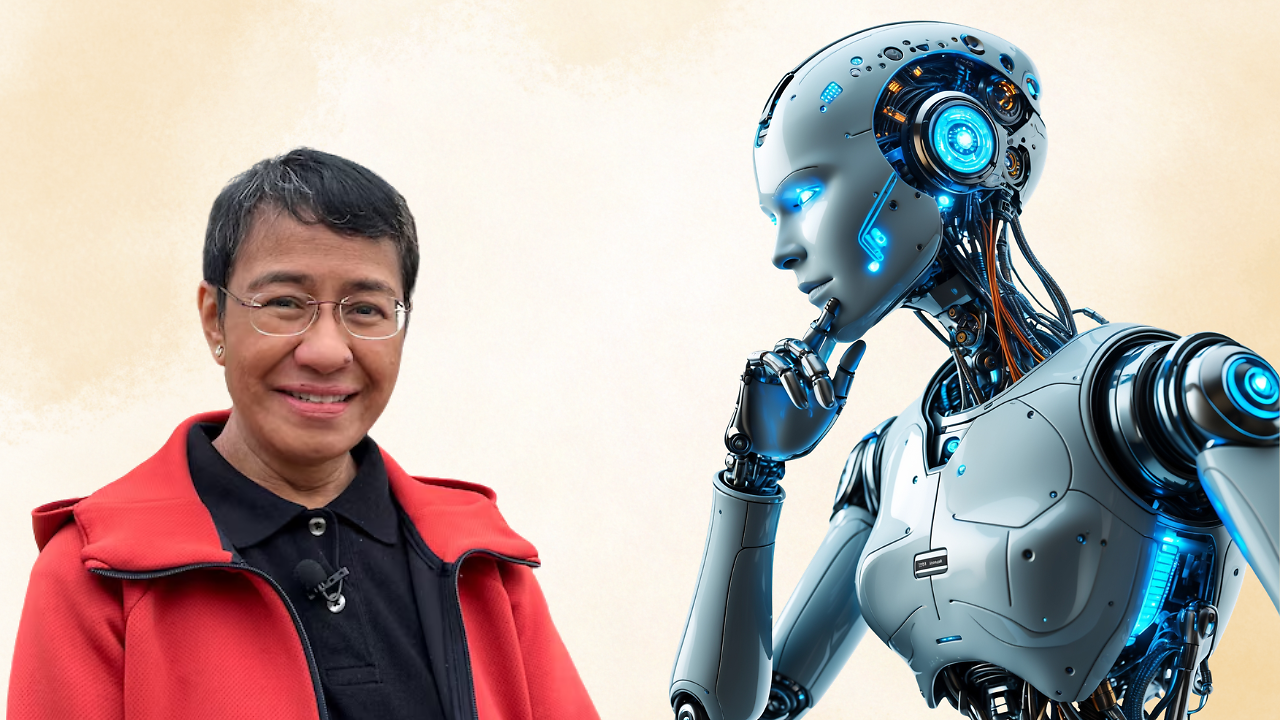
Amid the AI slow down debate, Nobel Peace Prize winner Maria Ressa has now warned that AI may eventually take away people’s ability to make independent decisions if governments fail to bring regulations soon, according to Reuters. Notably, she is not the first person to flag the growing AI risks.
Recently, the former US President Barack Obama, senator Bernie Sanders and Microsoft co-founder Bill Gates have also warned about the concerns related to AI. These comments come after Anthropic CEO Dario Amodei urged the technology industry to slow down the pace of frontier AI.
Here’s What Maria Ressa Said
Ressa is a Filipino-American journalist and co-founder of news organisation Rappler. She reportedly made the remarks during an interview in Oslo, where she was attending a conference on threats to democracy. She jointly received the 2021 Nobel Peace Prize for her work defending freedom of expression and investigating the influence of powerful technology companies.
She currently serves as co-chair of a United Nations international scientific panel on artificial intelligence, which examines the technology’s impact on people and societies worldwide.
Reportedly, Ressa said governments need to move quickly to prevent AI from becoming too powerful to control. She argued that asking for safeguards is not an attempt to restrict free speech but a necessary step to protect the public.
“It is not a freedom of speech issue to ask for regulation. It’s a public safety issue,” said Ressa, who is also Rappler’s co-founder and CEO. She added that people should actively campaign for stronger AI laws and put pressure on elected representatives.
“I think we’re at that phase where if this doesn’t happen, we will tip … (It) will be beyond our control if we don’t step in now,” she said.
Ressa described the development of AI and related technologies as a process that has unfolded through three major phases. She said the first phase involved social media platforms capturing people’s attention and influencing how societies interact.
“Artificial intelligence is neither artificial nor intelligent. It’s been around for about 70 years, and there have been three waves that have already hit the public,” she said.
She explained that social media had contributed to political polarisation and increased isolation among users. The next phase, according to her, involved chatbots that use human emotions and the desire for companionship to build deeper relationships with users. “The second phase was hacking our biology, again through intimacy: the chatbots,” Ressa said.
She identified the latest phase as the rise of agentic and multi-agentic AI. These systems are designed to perform tasks and take actions on behalf of people rather than simply responding to questions.
“And then the last one is agency itself, through agentic and multi-agentic AI, the frontier models that are creating these machines that don’t just pretend to be human, but act for us,” she said.
Some technology companies and political leaders, including US President Donald Trump, have opposed stricter AI regulations over concerns that such measures could weaken America’s position in the global race for AI leadership. Ressa dismissed the argument that regulation would put the US at a disadvantage compared with China. She said China has introduced safeguards for its citizens that are not always matched by technology companies operating elsewhere.
“China actually puts more safeguards in place for its citizens than Silicon Valley does for the rest of the world. If you’re on TikTok, the version of TikTok that is in China has age restrictions,” she said.
She also called for technology companies to take responsibility for the consequences of their products. Ressa welcomed legal action against Meta Platforms, which she said could result in the company paying up to $18 billion over the next decade and facing restrictions on how teenagers use Facebook and Instagram. “The very first one (step) is to actually make the companies responsible for the damage they’ve done,” she said.
