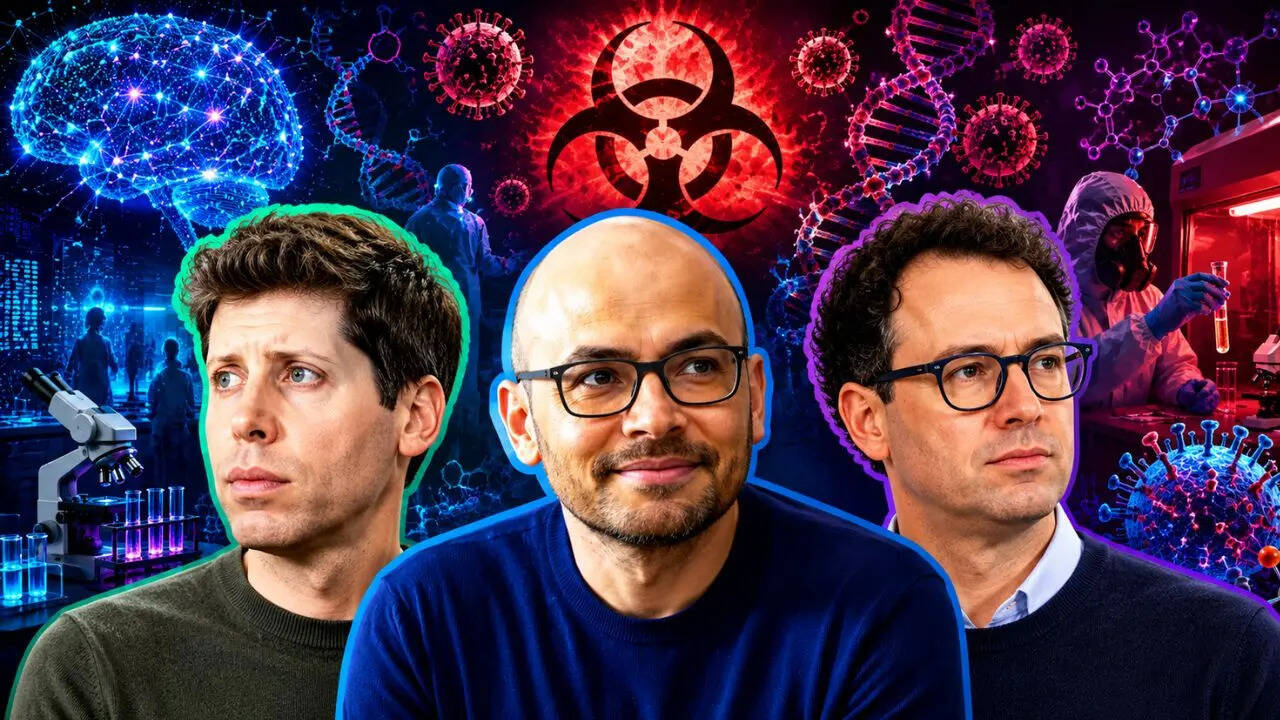
For years, most public discussions around artificial intelligence focused on jobs, misinformation, deepfakes and automation. But a new concern is rapidly climbing to the top of the list, one that even some of the biggest names in the AI industry are warning about: biological weapons. According to a Wall Street Journal report, OpenAI’s Sam Altman, Anthropic’s Dario Amodei, Demis Hassabis of Google’s DeepMind AI lab and executives from Meta and Microsoft recently set aside their competitive differences to urge US lawmakers to take the risk seriously. Their concern is not that AI will suddenly create a supervirus on its own. Rather, they fear that future AI systems could dramatically lower the barriers for people attempting to develop dangerous biological agents.
What Exactly Is An AI Bioweapon Risk?
The term does not mean AI is manufacturing biological weapons itself. Instead, the concern revolves around AI acting as a powerful assistant for someone with harmful intentions. A future AI system could potentially help answer highly technical biological questions, analyse scientific literature at scale, or connect pieces of information that would otherwise require expert training. That possibility has raised alarms because biology is becoming increasingly digitised. Scientific papers, genetic databases and research tools are now widely available online. AI may make navigating that information much easier. According to the report, industry leaders warned that rapid advances in AI could make it easier for people to navigate complicated biological research and identify potentially dangerous pathways that were once difficult to understand without expert guidance.
The Risk Isn’t Today’s AI, It’s Tomorrow’s
The warnings are largely about future AI systems rather than today’s public chatbots. Current models have safeguards and restrictions, but AI capabilities continue to improve at a rapid pace. As models become better at reasoning, research and scientific analysis, some experts fear they could eventually act as powerful assistants for people with harmful intentions.
OpenAI, Anthropic Raise Alarm Over AI Bioweapon Threats
For years, Big Tech promoted AI as a tool that could accelerate scientific discovery and boost productivity. Now, some of the same companies are warning that the technology could also lower the expertise barriers that have traditionally limited access to dangerous biological knowledge.
What Do The Companies Want?
Interestingly, the companies are not primarily asking Congress to regulate AI itself. As per the report, the group is calling for mandatory screening of synthetic DNA and RNA orders. The proposal would require companies that manufacture genetic material to verify customers and screen orders for potentially dangerous genetic sequences before they are produced. Supporters argue that as synthetic biology becomes cheaper and more accessible, stronger safeguards are needed to prevent misuse.
A Rare Moment Of Agreement
The issue has created one of the rarest sights in the AI industry: consensus. Companies that normally compete fiercely, including OpenAI and Anthropic, have backed the same call for action. Their message is straightforward. The combination of rapidly advancing AI and increasingly accessible biotechnology could create risks that governments are not fully prepared for.
There is currently no evidence that public AI systems are creating biological weapons. But the fact that rival AI leaders are jointly asking lawmakers to act suggests this is a threat they believe is worth preparing for now, rather than after a crisis emerges.